Monday, 9 February 2015

GREAT READS FOR FEBRUARY, 2015

The Petticoat Men, by Barbara Ewing
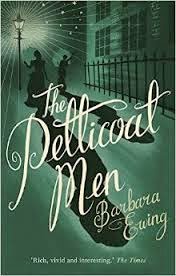
In 1870, a scandalous trial was conducted in London’s Old Bailey:  two young men of good family were charged with parading as women in public places.  As if that weren’t salacious enough, later charges of sodomy were brought against Ernest Poulton and Frederick Park, who swore that they only wore women’s clothing in their roles as actors in various revues:  ‘we are not guilty of these shocking and scurrilous charges, sirs!’
            But who doesn’t love a scandal?  The tabloids were just as industrious 145 years ago as they are today, and Victorian gossipmongers delighted in anything printed about The Men in Petticoats, not least because Park and Poulton weren’t the usual Hoi Polloi;  they had connections, especially to the Nobility:  how delicious to read (if you could) that the Upper Classes had their fair share of deviates, in spite of their impassioned denials.
            Author Barbara Ewing has reconstructed as a novel The Crime of the Century, fleshing out Ernest, too beautiful to be a man, and Frederick, the second son of an eminent lawyer to be charged with buggery – and the more humble people they affected with their charades:  the Stacey family, from whom both men rented a room casually – ‘We just need a place to store our gowns and change into them occasionally, dears!’, and the consequences of their deceit on Mattie, daughter of the landlady, and champion of them both in the courtroom – until she is forced to concede that her idols have feet of clay, especially when their lodging house is covered with graffiti and she is branded a crippled whore.
            As the trial progresses, it becomes clear that powerful people will do much to keep the details of Ernest and Freddie’s indiscretions to a minimum – who cares who gets trampled upon in the process, as long as the Great and the Good are not exposed:  small fry like the Stacey family are entirely expendable - but Ms Ewing has done a marvellous job of convincing the reader that justice eventually prevailed, despite the lamentable double standards and hypocrisies of the age.  Her characters smile at us from the pages, damaged, ebullient, charming and villainous:  this novel, the facts meticulously researched, reads like a thriller, as thrilling as the real case of The Men in Petticoats 145 years ago.  Ms Ewing presents a compelling portrait of the times:  God-fearing, strait-laced on the surface – and embracing a netherworld of corruption beneath.  Highly recommended.


The Mountaintop School for Dogs, by Ellen Cooney

Blurbs by famous authors on book covers can sometimes achieve the opposite of what they intend, which is to convince the reader to read said book.  When I read ‘this book will grab your heart and not let go’ my toes curled:  oh dear, yet another heartwarming tale guaranteed to be forgotten five minutes after it’s finished.
            Well, I decided anyway to give Ellen Cooney’s heartwarmer a try;  I haven’t read anything else of hers and I thought (meanly) that I didn’t have to finish it if it was too saccharine.
            So!  I humbly stand corrected:  Ms Cooney’s story is indeed heartwarming, but in the best possible way, for her characters are all too real, too credible and broken to not remind us of ourselves or of people we know.  This little book is a gem.
            Evie (we never know her last name) applies online to become an apprentice dog trainer at a dog rescue sanctuary in a remote mountain town (name or State never mentioned).  She is searching for a career, a long term vocation, something that will fulfil her need to use her high intelligence, to make a difference to – anything, or anybody.  Even though she has never had a pet and knows nothing of dogs,  Evie feels she has to remove herself from her present environment, and what better way to start afresh than somewhere no-one would think to look; a place where the occupants would require her help, not the other way round, as it is at present.
            And the occupants do need help – lots of it, from the little Scottish terrier who was abandoned to starve in an apartment by her owners when they left rather than pay the outstanding rent;  the Rotweiler who was pushed out of her owner’s car and ran after it for miles before giving up;  the wee terrier who was also abandoned as soon as a baby came along to replace her.  And so on.  And so on.  Evie’s initial task is to make friends with these dogs who no longer trust humans, to restore their faith in the goodness of humans – to help them to feel like Man’s Best Friend again.  For Evie this is a tall order.  She has never been best friends with anyone.  But perhaps that fact eventually gives her a better insight into the ways a rejected and crushed personality feels:  Evie knows all about rejection.
            And the longer she stays at the Sanctuary, she realises that it’s not only the animals who need the affirmation of friendship and affection;  everyone who is employed there has their own story to tell, their own reasons for being there.  The Sanctuary is a haven for all those who are sore of heart and tired of spirit, but united by their common wish to make their world a better place for animals – and themselves.
            Evie is asked at the beginning of her stay to explain her reasons for wanting to work at the Sanctuary, and because she has been rather less than honest in her application, she delays her answer as long as she can – then, finally she thinks to write this:
Came in as a stray,
Is not completely hopeless,
Please allow to stay.

            Well done, Ms Rooney.  This is a lovely story.  Highly recommended.     


Tuesday, 27 January 2015

MORE GREAT READS FOR JANUARY, 2015

The Rent Collector, by Camron Wright

In 2009 Camron Wright’s son Trevor filmed a documentary in Cambodia called ‘River of Victory’, an account of the appalling poverty and daily struggle for survival of the inhabitants of Pnom Penh’s huge municipal waste dump.  These people had come to the city from even more privation in the country to try to make a living;  as peasants most were illiterate, but all had one thing in common:  a huge work ethic and powerful desire to make a better life for their loved ones.
            The struggles of one such family in the film inspired Mr Wright to turn the family’s travails into an extraordinary, novelised account of their refusal to yield to the squalor of their everyday existence, and their ultimate success in making a better life for themselves. 
            Sang Li, her husband Ki Lim and their baby boy Nisay eke out a precarious living as trash pickers for recyclables at Stung Meanchey, ‘The River of Victory’ – which is anything but:  acres of noisome garbage tower over everything;  when it rains the water collects and stagnates in filthy channels that everyone tries to avoid at all costs:  cuts and scratches suffered while picking through the rubbish easily become infected, and medical help isn’t cheap.
            The lives of everyone at Stung Meanchey are precarious;  they are all grindingly poor, but they all have to a greater or lesser degree that vital emotion to get them through each day:  hope.  Hope that the next day will be better, that the pickings will be larger and get them a bit more money from the buyers who gather at the end of each shift – and the hope that eventually, they will be able to move on from Stung Meanchey.
Sang Li and her husband work as hard as everyone else, but their progress is hampered by the failing health of their baby Nisay, who is continually beset by fevers and diarrhoea, and the predations of the gangs of young boys who roam the dump, looking to rob the vulnerable.  Every time Sang Li saves enough money it is eaten up by the cost of medications for Nisay whose symptoms reappear as soon as the pills are finished, and like everyone else, Ki Lim has been attacked and robbed by the gangs of the little money he earned after twelve hours picking through garbage.
The family is desperate:  they haven’t enough money to pay the rent on the hovel in which they live, and they know that the loathed Rent Collector, a spiteful old woman known for her complete lack of compassion – and her drunkenness – will accept no excuses:  she wants her money.  NOW!
Until a miracle occurs:  someone has given Sang Li a picture book they found amid the garbage, thinking it would be good for Nisay;  when the Rent Collector chances upon the book she is disarmed.  Weeping at the sight of it, she takes the book without mentioning the rent.  
Sang Li is intelligent -  she realises that the Rent Collector can read:  can she profit from this situation?  Can she convince the Rent Collector to teach her to read, for Sang Li knows that literacy is the doorway to knowledge:  knowledge creates opportunity.
And literature is at the heart of this remarkable story, for in a former life the Rent Collector taught literature at a prestigious university.  She is an ideal vehicle through which Mr Wright explores human stories, real and imagined;  the Rent Collector delivers a fine education to Sang Li, her last pupil - and many compelling, brutal and unforgettable life lessons as well.
Mr Wright is such a skilful storyteller that it is impossible for the reader to discern where reality ends and fiction begins:  suffice to say that this reader doesn’t care – the message is loud and clear:  hope is the key.  Highly recommended.

The Bright Side of my Condition, by Charlotte Randall

In the first years of the nineteenth century four stowaways on a sealing ship are left on an uninhabited island in the Southern Ocean by the captain, furious that they should try to hide themselves on his ship;  he didn’t have enough to feed his legitimate crew, let alone four escaped felons from Norfolk Island.  Well, they could earn their passage back to Sydney town by collecting seal pelts;  he would be back in a year to collect them.
Thus does their privation begin. 
New Zealand author Ms Randall has a very large following here;  this is her seventh novel (see May 2011 review of ‘Hokitika Town below) and is based on actual events:  four stowaway felons were indeed marooned on one of the Snares Islands and instructed to collect sealskins to earn their passage home;  unfortunately, the ship’s captain didn’t  return to collect them in a year:  nearly ten years would pass before they saw a sail on the horizon.
The story is narrated by Bloodsworth, a thief and layabout, transported from England to Norfolk Island for stealing (amongst other things) a length of lace.  His reluctant companions are Slangham, who murdered his wife;  Gargantua, or Fatty (until privation peeled the weight from his bones), and Toper, a superstitious and God-fearing Irish Catholic drunk not known for deep thinking.  Gargantua is reluctantly acknowledged to be of an intellectual bent – he can recite huge swathes of poetry, especially that of Rabelais, his favourite.  He is also a classic stirrer and takes smug satisfaction in setting his fellows against each other;  it gives him some small pleasure to manipulate those he considers less clever than he.
Slangham is a workhorse;  he drives the others mercilessly to provide the skins that they hope will eventually earn their freedom, and he takes no pleasure in life that anyone can see:  he is a volcano of hatred and misery:  he hates himself and everyone else.
Bloodsworth, initially aghast and horrified at their plight eventually reconciles himself to their environment and learns to love the spectacular wilderness and wildlife of the island.  For the first time in his life he feels truly free.
And therein lies his downfall:  his mind must be sick to enable him to actually feel so rebellious;  to stop taking orders from Slangham, self-appointed ‘boss’;  to please himself what he does each day:  no, something is wrong.  They cannot have a madman in their midst.  He must be punished.
Ms Randall does not put a foot wrong in this masterly tale;  the island, paradise or hell according to the weather conditions, is described in gorgeous imagery and her characters are all too real, especially Bloodsworth who has a conscience that weighs more than the world – but just in case readers think this is a tale of unremitting gloom, gems of humour like rays of sunlight illuminate the story at strategic points, enhancing more – if it were possible – the reader’s enjoyment.  This is a great story.  Highly recommended.    


Hokitika Town, by Charlotte Randall

The year is 1865;  the great Gold Rush is well under way and Hokitika is booming;  there are 100 pubs throughout the town to slake the miners’ thirst – and relieve them of their hard-won gold, and everyone is trying to get rich quick by fair means or foul before the gold runs out and all the diggers move on to the next Big Strike. 
Into this hotch-potch of goodies and baddies comes  Halfie – Half-pint, Harvey, Bedwetter, Monkey:  these are only some of the names he answers to, this little maori boy who has run away from his tribe after the death of his beloved tuakana Moana.  Being a resourceful and intelligent little boy he has decided to be a ‘coin boy’, and where better a place to earn coin than Hokitika town – he is sure that he will eventually accumulate enough coin to earn a place to sleep by the stove of the reclusive miner and drunk, Ludovic, with the hope that Ludovic will teach him English.  He knows that ‘That Inglish is a langwich what don’t behave’ and he would appreciate some tuition so that he can get fair treatment from Whitey.  Besides, he’s sick of sleeping up a ponga tree – that’s tolerable in the summer, but Hokitika gets a lot of rain and it’s coming onto winter, so he has to plan ahead.
Thereafter follows a rollicking account of Halfie’s adventures as a coin boy,  in his own fractured and inimitable style:  comedy and tragedy vie equally  for places in this wonderful story of great riches and hard times portrayed by a writer of superlative skill.  Halfie is ebullient, shrewd, hilarious, and quite simply unforgettable as he  bravely attempts in his little boy’s way to deal with problems that most adults would  flee rather than solve:  sometimes ‘his heart sag like a old bed’ when his mind turns back to ‘rememorying’, but he has a lion’s heart,  a fox’s cunning and a nobility of spirit that many adults would never achieve in a lifetime. 
His friends – and enemies – are wonderfully drawn, too;  an astonishing cavalcade of the Good, the Bad, and the downright Ugly, and all utterly convincing.  Ms. Randall has brought our Goldrush era to thrilling life:  as Halfie would say:  KA PAI!  And I would say A-MA-ZING 


Tuesday, 6 January 2015

GREAT READS FOR JANUARY, 2015

Blue Labyrinth, by Douglas Preston and Lincoln Child

Special FBI Agent extraordinaire Aloysius Pendergast returns yet again to do battle against the forces of evil – and not before time, I say!  His myriad fans have been languishing without him, and it’s all very well for Messrs Preston and Child to throw them a bone from time to time with various solo novels and the combined authorship of a series featuring a new hero, Gideon Crew, BUT.
All that secondary activity is a mere distraction until the Master resurfaces, this time to fight a mysterious new villain, one who has hidden his identity so well that more than half the book is (greedily) consumed before his identity is revealed.
In common with all the other evil ones that Pendergast has dispatched to the hereafter, (see 2013 review below) Mystery Man is festering with hatred towards our pale hero -  but he is no ordinary Dastard, for he is motivated by revenge:  thanks to an awful genetic curse wrought upon his family by one of Pendergast’s ancestors, Mystery Man contrives through absolutely genius planning, to infect Pendergast with the same fatal malady - but not before leaving the dead body of Pendergast’s twin son on the Agent’s front doorstep as a calling card and to start the ball rolling.  Pendergast’s days are numbered!
Now.  Because Pendergast knows something about absolutely everything he is able to self-medicate for a while as he searches for his killer, but as the horrid disease starts to have its wicked way, raising his temperature uncomfortably in his black wool suits, he realises that the cavalry will have to be summoned – and who better to ride to his rescue than Margo Green, anthropologist and ethnopharmacologist,  doughty companion on many previous bloody adventures at the New York Museum of Natural History.  It will be her job to manufacture ASAP an antidote from rare  ingredients pinched by none other than Constance Green, Pendergast’s mysterious ward – well, she’s certainly mysterious to ME, as I haven’t yet found the book (and I thought I had read them all) where she makes her first appearance.
By any reader’s calculation she must be about 150 years old, but is as young and glowing as the dawn;  the only clue to her advanced years is her curiously formal way of speech, and her retro fashion sense, but – but the woman is an Amazon!  And she knows HEAPS about various acids, and how to administer them to nasty men who should know better than to try to stop her at the Brooklyn Botanic Garden from stealing a super-rare plant to save Pendergast’s failing life.  Constance Green is a warrior, and she accomplishes grand larceny and mass murder in minimum time and maximum efficiency (he’s definitely worth it!) clad only in a silk Teddy.  Sorry, Constance:  chemise.
Does Our Hero survive?  Well, what a silly question:  of course he does, returning to his healthy pallor in no time at all, and enjoying a fresh supply of Armani funeral garb.  And he and Constance are closer than ever, which is only right:  she rubbed out half an army of mercenaries that he might live!  Do you suppose she fancies him?  Watch this space.

White Fire, by Douglas Preston and Lincoln Child

As patient readers of this little blog will know, I have long been a fan of Preston and Child’s fearless protagonist FBI Special Agent Aloysius Pendergast, along with millions of other dedicated followers of his hair-raising adventures as he deploys his considerable intellectual and physical powers to defeat all manner of dastardly villains.  Sadly, ‘Two Graves’ the white-knuckle adventure preceding this latest title was so absurd, so defying of all credulity that I couldn’t in all conscience write my usual ecstatic review – I mean, come ON:  a nest of evil  NeoNazis in the South American Jungle conducting eugenic experiments so that they can breed another Master Race, and who should be involved but Pendergast’s great love Helen, mother of twins he didn’t know he’d fathered (gasp!), one of whom is bred specially for great things, and the other (double gasp!!) for slavery. 
Our hero destroys the nest of evil Nazi vipers, but at great personal cost (Helen really does die this time), causing Pendergast to sink into a slough of despond from which he has great difficulty extricating himself, BUT!
His creators need to bring him back from his hell of substance abuse and depression for this latest adventure, and I am happy to say that ‘White Fire’ is a complete success, with only limited reference to ward Constance Green ( meditating in a monastery in the Himalayas) and his good and evil twins (of the nasty one no trace;  the good one is getting an education at an exclusive Swiss Academy).  Instead this adventure centres on Corrie Swanson, Pendergast’s sponsored protégé and student at the prestigious John Jay College of Criminal Justice. Corrie has decided to base her thesis on the supposed slaughter by a bear of eleven miners 150 years ago in a remote area mined for silver in Colorado. 
By great coincidence the rough mining camp of Roaring Fork has now become the exclusive ski resort and winter vacation wonderland of the megarich and famous – and others who find Corrie’s desire for information and request to examine the exhumed bodies of some of the miners intrusive and unhelpful:  she must be discouraged permanently from her investigations and with a ruthlessness that takes Corrie’s breath away, she suddenly finds herself in prison facing a ten-year sentence for ‘desecration of a corpse’ and various other lesser charges. 
Her devastation is absolute – until Pendergast, finally roused from his torpor by her desperate situation arrives in Roaring Fork complete with the necessary evidence to refute the charges and send a message to the villains that their nefarious plans are not going to succeed.  Oh, it’s great stuff, and as an added bonus Oscar Wilde, Sir Arthur Conan Doyle and his great hero Sherlock Holmes are connected to Pendergast’s modern day sleuthing in an entirely credible subplot, forming the basis of his ultimately successful solving of The Mystery – but not before Corrie undergoes some truly death-defying experiences (she has her little finger shot off and nearly goes up in smoke for being unwittingly lippy to a madman), as required in any suspense novel worth its salt. 
It is a pleasure to welcome Pendergast back to the land of the living –at least as portrayed by Preston and Child:   his mourning period is now thankfully over and he can attend to his usual business of conquering evil, striking fear into the black hearts of villains everywhere with his pale eyes, pale hair and an inexhaustible supply of money and black designer suits.  Lincoln and Child are back to their best:  sound scholarship, good research and a great plot.  Who could ask for more?  This is the ideal holiday read.

The Woman who Stole my Life, by Marian Keyes

Stella Sweeney is a beautician in Dublin.  Her husband Ryan is a thwarted artist (his talent was never recognised or appreciated but he has channelled his gift into making posh bathrooms for posh people); they are parents to  a teenaged boy and girl who require a lot of supervision and organising, and it is a source of great pride for her to know that despite she and Ryan’s working-class origins, they can afford (just) to send their children to an exclusive private school.  Nothing but the best for Jeffrey and Betsy.  They are Stella’s main focus in life;  her reason for getting up in the morning.  Ryan is another matter – his main focus seems to be on his business, then Ryan:  the grand passion that controlled their young lives has now disappeared, lost in the stresses and strains of everyday living – so what else is new?  This is what happens to us all, and that is the secret of Marian Keyes’s success:  her great ability to recount stories of people just like us, her readers;  people we can identify with so easily.
Where Ms Keyes starts to leave reality behind is the unbelievable misfortune Stella suffers when she contracts Guillain-Barré Syndrome, ‘an  auto-immune disorder which attacks the peripheral nervous system, stripping the myelin sheaths from the nerves’.  Got that?  The body can recover eventually, but until that happy day, Stella spends a huge amount of time in hospital, paralysed and unable to communicate at all – except after a time to establish a winking, blinking code with a hunky neurologist who – quelle horreur! – eventually becomes her (gasp) lover!  How could this happen to someone who couldn’t move a muscle for more than a year?  And what about hubby and the kids?  A?  A?  More importantly, how does a writer convince her readers that this is just an everyday occurrence?  Well, I have to say with some regret, that she didn’t convince ME – which is a shame, because I was entirely willing to suspend belief – up to a point.
Never mind, though:  for the most part, Ms Keyes writes beautifully of what she knows i.e. the publishing world, this time exposed in all its two-dimensional ugliness, and her supporting characters are as strongly drawn as ever.  Lastly, let us not forget her biggest virtue as a writer:  humour.  That wonderful Irish variety of humour, so inimitable and so vital;  such an arsenal against all the troubles that beset us ordinary folk and without which we would be defenceless indeed.  Ms Keyes may have missed the bus with ‘The Woman who Stole my Life’, but I’ll be waiting for her at the next stop. 


Saturday, 27 December 2014

THE DECEMBER FIRST FIFTEEN!

2014 – not long now before this year fades into history and we will be greeting a brand new year:  here at Te Takere, our beautiful library and community centre in Levin, New Zealand (check out our Facebook page), the staff and volunteers (that’s me!) wish you a most happy and healthy 2015 and, in common with all the (marginally) more well-known lists of what’s currently hot in the world of contemporary fiction, I present for your entertainment MY list of the very best books I have reviewed this year:  MY FIRST FIFTEEN.  They are not in order of preference, but in date order as I reviewed them;  the full review of each title can be accessed on that month’s posting.

The Goldfinch, by Donna Tartt   reviewed January

My Notorious  Life, by Kate Manning   reviewed April

The Blind Man’s Garden, by Nadeem Aslam  reviewed May

The Enchanted, by Rene Denfeld   reviewed June

Prince of Fools, by Mark Lawrence   reviewed June

He Who Kills the Dragon, by Leif G.W. Persson  reviewed July

Love and Treasure, by Ayelet Waldman   reviewed August

Remember Me Like This, by Bret Anthony Johnston   reviewed August

The Guts, by Roddy Doyle   reviewed September

The Secret Place, by Tana French   reviewed September

The Giver, by Lois Lowry    reviewed (finally!) October

The Drop, by Dennis Lehane   reviewed October

The Wolf in Winter, by John Connolly   reviewed  November

All the Light we Cannot See, by Anthony Doerr, reviewed November

Revival, by Stephen King   reviewed December.  (See below)

If I had to nominate top titles, then it would be a toss-up between Donna Tartt’s ‘The Goldfinch, and ‘All the Light we Cannot See’ by Anthony Doerr, both masterworks of modern fiction, followed by ‘The Enchanted, by Rene Denfeld.  How lucky are we to enjoy such peerless writing, but the same can be said of all the titles on the list, and how lucky are we that we have such great titles in the library stock, readily available to all.

Revival, by Stephen King.

One of the secrets of Mr King’s enormous success as a writer is that his protagonists are the usual flawed, everyday people that we can all identify with -  then he unleashes his soaring imagination and has unbelievable things happen to them, and part of his huge talent is to make the reader believe utterly in the credibility of his plotting.   I am constantly amazed at the unflagging energy that he possesses to produce a new book each year;  each one completely different, and each one – if that is possible – better than the last. ‘Revival’ is the latest addition to this enormous body of work, and yet again Mr King takes us on a journey that we would rather not make, but find impossible to resist.
Jamie Morton is six years old in 1962 when he first meets young Methodist minister Charles Jacobs who has come to the Morton’s small Maine town as a replacement.  Like every other Methodist in town, Jamie and his family are charmed by Charles, and all the young boys are in love with Mrs Jacobs because Mrs Jacobs is gorgeous – ‘youth was her makeup’ and it makes her glow.  The reverend and his wife also have a sweet little five-year-old boy, Morrie, and appear to be very happy with their new placing. 
When the reverend isn’t occupied with his pastoral duties he indulges himself in an unusual hobby:  a big interest in electricity - not its obvious power to heat or to light the surroundings but most of all, a belief in its power to heal.  He is convinced that eventually electricity will be used for curing all kinds of illnesses, even the hopeless cases.  Jamie is not convinced:  he thinks the reverend has his wires crossed – God figures out who should be healed, not electricity! 
As time passes, Jamie comes to love and admire the reverend, as do most of his congregation – until a shocking tragedy occurs which transfixes the whole town:  reverend Jacobs loses his wife and son in a terrible road accident,  causing him to lose his faith and to preach one last homily ‘The Terrible Sermon’ in which he professes his rejection of God and all religion.  The townsfolk are stunned and Charles Jacobs disappears from Jamie’s life forever – he thinks.  But as the years go by and his life path takes several bad turns, it is Jamie’s fate to meet up with the reverend again – whether he wants to or not.
By the time Jamie has reached his lowest ebb, the reverend Jacobs has become Dan Jacobs, carnival trick photographer, masterly at relieving ‘rubes’ of their money;  regardless, he is still there to help and ‘heal’ Jamie when his need is most desperate:  when Jamie sees him again many years later, Dan Jacobs has become Pastor Danny, renowned faith healer, dispenser of that good old fashioned hallelujah religion he scorned and rejected after the deaths of his beloved family – but scarily, many of his professed cures appear to work.  Notwithstanding, Jamie knows from his own experience of being ‘healed’ that there are vicious and inexplicable after-effects.  If he investigates his old friend further and tries to stop more ‘cures’ and electrical experiments, will he have a tiger by the tail?
We are all propelled inexorably towards the last terrible electrical ‘cure’, the object of the reverend’s lifelong quest to speak to his dead family once more, and I have to say (cynic that I am) that I found the climax to be the weakest part of an otherwise superb story.  Various allusions to Mary Shelley and her masterwork were clumsy and the monsters who made an appearance caused me to quake with laughter rather than fear – but, hey!  After 400 pages, Stephen King only fell at the last hurdle:  most times he wins the race.  (see July 2014 review below).  STILL highly recommended.

Mr. Mercedes, by Stephen King

Former Detective K. William Hodges is nearing the end of his tether.  Since he retired from the city Police Force, life has lost its edge;  there is nothing meaningful to relieve the boredom of his days, most of which are spent watching inane TV shows, eating junk food and drinking too much. 
Some days are worse than others:  on those days he contemplates suicide and sits in front of his TV with his father’s gun by his side – until the day he gets a letter, purportedly from a man who mowed down a line of job seekers in a stolen Mercedes, a case that was still unsolved when he retired.
The letter writer seems to know a lot about Bill Hodges, including details of his first name (Kermit); information about his farewell bash (it was a drunken riot of fun!); and even more chilling:  insider knowledge of Bill’s suicidal thoughts.  Is this monster a mind-reader?  How does he know so much? 
The general tenor of the letter is designed to increase Bill’s feelings of worthlessness, to push him into that last act with his father’s gun:  ‘it would be too bad if you started thinking your whole career had been a waste of time because the fellow who killed all those Innocent People ‘slipped through your fingers’.
But you are thinking of it, aren’t you?  I would like to close with one final thought from ‘the one that got away’.  That thought is:
F--- YOU, LOSER.
Just kidding!
Very truly yours,
THE MERCEDES KILLER.’

Once again, Mr King takes the reader into the dark places of minds and hearts with his usual effortless skill.  In this latest opus there is nary a hint of the supernatural for which he is so famous; not a spectre in sight:  instead he writes of the monsters that contemporary society creates who walk among their unsuspecting victims disguised by spurious normality -  as here, where the Mercedes killer is revealed early in the plot as Brady Hartfield, dutiful son of an alcoholic mother and hard worker at two jobs, one as a computer technician, the other driving an ice cream van.  What could be more normal; (even a little sad – the sacrifices that boy makes for his mother!) he works super hard at blending in with everything and everyone – why, he’s practically invisible!
But not infallible.  Contrary to his expectations, his letter has given K. William Hodges (Det.Ret.) a huge boost;  the depressive clouds have parted – his mind, always keen, has something to grapple with again:  start playing the game, Mr Mercedes.  Let’s see who wins!
As always, Mr King provides his main protagonists with great supporting characters, in this case Jerome, Bill’s 17 year old lawn and odd job boy – who just happens to be black, highly intelligent and a computer whizz – but not half as whizzy as Holly, a true PC Maestro who unfortunately is plagued with ‘issues’.  They are Bill’s doughty assistants.  Their dialogue is perfect, crackling and comic (how I wish I could remember some of those one liners!) but it never distracts us from the horror and creeping suspense of a great story.  Mr Mercedes is going to strike again.  But where?  When?  And can they stop him?
Stephen King has once again held a mirror up to contemporary society, and it shows a chilling image, one that is very hard to look at.  Highly recommended. 


Friday, 5 December 2014

LAST GREAT READS FOR NOVEMBER,2014

The Wolf in Winter, by John Connolly

The town of Prosperous, Maine lives up to its name.  Founded in the eighteenth century by persecuted religious fugitives from England, the settlement grew and gradually flourished, whilst still retaining quaint old buildings (why, they even brought their own church with them to assemble, brick by brick!) and  customs.  The town is still governed by a hereditary council of Selectmen, all descendants of the original inhabitants and, while displaying courtesy to all who come to visit such a picturesque place, it will be eventually noticed that Prosperous does not welcome new people to live within its limits:  Prosperous keeps to itself.
            Until the apparent suicide of Jude, a homeless man who visited the town searching for his daughter, brings private detective Charlie Parker looking for answers:  while it is hardly unusual that a man of the streets would want to end his life, the method of death feels wrong, especially when Charlie checks into Jude’s movements in the days before his death.  Jude had helped Charlie in the past;  it is now up to Charlie to do the right thing.  If Jude’s death was indeed suicide, was it because of his daughter?  Is she dead, too?  And if so, why?  How?
Yet again, Mr Connolly draws the reader into the web of Charlie’s latest dark adventure.  In modern Man of Sorrows Charlie Parker and his two murderous sidekicks Louis and Angel, Mr Connolly has created three unforgettable protagonists – and their enemies are legion, especially The Collector, a self-appointed avenging angel of righteousness, dedicated to ridding the world of those so evil that no lawful punishment is fitting enough. 
Charlie, Angel and Louis have undergone more than one baptism of fire in preceding books to seal their bonds of friendship and loyalty, but when they face the chilling mystery that is Prosperous, one of their number is so grievously wounded that, even as this great book comes to a close it is impossible to guess if he will survive, let alone appear in a sequel.
I take my hat off to Mr Connolly, first of all in praise of his wonderful literary skills:  there are many writers who tell great stories but there are few who write with such clarity and elegance.  And it takes a rare talent to make the supernatural element of every Charlie Parker story so credible, and all the supporting characters so real that they are itching to step off the page and do us harm.
That said, how long will it take Mr Connolly to produce his next book – will there be a next book, with the life of one of the Three Dark Musketeers hanging in the balance?  It’s a big worry, one that I hope will be removed soon.
In his acknowledgements at the conclusion of ‘The Wolf in Winter’, Mr Connolly thanks his readers for continuing to read ‘these odd little books’.
As if we could stop.  AS IF!!  Highly recommended.

All the Light We Cannot See, by Anthony Doerr.

Werner and Jutta Pfennig are orphaned when they are very small;  they live a precarious existence in 1930’s Germany at Children’s house, an orphanage in a mining town outside Essen in the Ruhrgebiet.  Despite their deprivation they are happy in each other’s company and secure in the love of Frau Elena, who keeps home and hearth together, caring selflessly for each child left with her.
            Both children show an aptitude and intellectual curiosity beyond their years, Werner for Radio Mechanics (he builds a radio out of next-to-nothing at age eight) and Jutta for Art.  As she grows, Jutta is increasingly disturbed by what she sees happening in her country and is inclined to voice her relentlessly logical opinions of the new order at all the wrong times.  Werner is more cautious, especially when he earns the opportunity to attend a school for gifted boys:  he hopes Jutta will keep her mouth shut so that his prospects of bettering himself won’t be ruined.
            Marie-Laure lives in Paris with her father, Daniel.  She became blind at the age of six and relies completely on him to show her ways through her sightless world.  He is a locksmith and safebuilder and has charge of all the locked, precious places of the Museum of Natural History;  six days a week they rise early to go to his job, and while he works, Marie-Laure gets an education from various Professors, all eager to impart their specialised knowledge to a child whose attention is absolute, enhanced by sound and touch, undistracted by extraneous images.
            In 1940 the prospect of the German invasion of France becomes a terrible reality:  the Museum sets about hiding its most priceless possessions elsewhere, for it is well-known that the Nazis wish to plunder the museums of Europe to fill their own galleries with ‘appropriated’ treasures – those that Göring does not want, of course.  Marie-Laure’s father is given the task of smuggling the Museum’s most prized gem, ‘The Sea of Flames’ out of Paris to a safe location at Evreux:  tragically, everyone else is fleeing Paris ahead of the Germans at the same time – what should have taken hours takes days, and when Daniel and his exhausted, sightless child arrive at the Chateau where he thinks he can at last leave the huge responsiblility the Museum has given him to someone else, they find everything looted, ransacked and ruined.  The owners have fled.
            Instead of returning, minus the precious gem, to their apartment in Paris, they are forced to seek shelter at St. Malo on the Breton Coast.  Daniel’s great-uncle lives there in seclusion;  his experiences in the Great War have made him a recluse but he provides shelter and stability for the fugitives at a time when they need it most – until August, 1944 when war and death come to St. Malo , as it did everywhere in France.
            Werner, meantime, has found that the school in which he centred all his hopes for the advancement of a scientific career is more interested in producing the perfect Aryan soldier, and despite excelling in his chosen subjects – and witnessing acts of brutality and sadism against his gentle, principled best friend – he is not sent to Berlin for further education as he had hoped, but sent to the front instead.  Germany is losing the war and they need every able-bodied man or boy that they can find.  Werner’s disillusionment is complete:  he now sees what his sister Jutta saw with such clarity nearly a decade ago.  As he and his radio unit limp into St. Malo in August, 1944 he despairs for his dashed hopes, his foolish dreams of a distinguished life of science:  eighteen years old and his life looks like it will soon be over before it has even begun.
            Mr Doerr writes of the parallel lives of Marie-Laure and Werner with dazzling skill;  such are his talents that each time we leave one character we are regretful – until we are swiftly bound up in the life of the other.  At no time does his story descend into sentimentality, nor is one country condemned more than another;  instead he writes of human nature:  kindness, greed, nobility, brutality, and the familial love that binds most things together:  the very glue of humanity – until war rips everything apart.
            This book is very special.  Mr Doerr makes his words sing.  Highly recommended.    


Wednesday, 19 November 2014

MORE GREAT READS FOR NOVEMBER, 2014

One Kick, by Chelsea Cain

For the myriad fans who have read every book in the Archie Sheridan/Gretchen Lowell series, Chelsie Cain needs no introduction:  she is an acknowledged master of the suspense genre, expertly following each rule of the formula:  a courageous, damaged protagonist;  a possible romantic interest surrounded in mystery – but with exceptional qualities;  some really sick but diabolically clever villains;  and a strong cast of credible supporting players.  After six successful books in the ‘Heartsick’ series, Gretchen and Archie should really disappear into the sunset:   for this reader their love/hate affair has lost its oomph, and it is time for a change.  Ms Cain does not disappoint.
In ‘One Kick’, Ms Cain’s protagonist is Kit Lannigan – who prefers to be called Kick, needing a point of difference however small, from her given name, famous as it is, for Kick was abducted by a child pornographer when she was six years old.  She was missing for five years until the FBI raided her ‘father’s’ farmhouse hide-out, unaware that a child would be secreted with him:  her miraculous survival and subsequent return shocks and thrills the nation.
It also brings its own set of problems:  the break-up of her parents’ marriage and the transformation of her mother into ‘the Kidnap Mom’, a cosmetically enhanced, frequent guest on daytime TV and author of a best-seller on the whole dreadful experience;  years of counselling and treatment for Kick from various therapists, many trying to give her the strength to appear on the witness stand to testify against her abductor;  and acknowledgement of the sad, brutal fact that she has no-one to rely on in this world but herself.
To that end, Kick tries to arm herself in every way she knows how:  over ten years she has become a crack shot;  she can pick locks with ease;  she is a diligent and successful martial arts student and a knife thrower supreme.  She has transformed herself into a killing machine – with an obsession:  to find other children who have been kidnapped, the children that still disappear with distressing regularity from playgrounds and their own back yards;  to restore them to their agonised parents, and to provide some ease to her aching heart by doing so.  Her life has little pleasure in it, except for the love she has for her old dog, and another wounded and damaged soul whom she rightly regards as her brother – after all, he has suffered the same abuse as she.
Then the proverbial Mysterious Stranger appears in her apartment (he’s a good lock-picker, too).  In an effort to find the latest missing children, he wants to pressure her to remember everything she most wants to forget:  the horrendous methods paedophiles use to abduct and imprison the most vulnerable;  the typical remote locations in which they are hidden, and the ways of making the children docile through terror.
Mysterious Stranger Bishop is one big question mark:  he has great wealth at his disposal;  he has solid contacts in the Police and FBI (not that they like him particularly) and he certainly has a personal agenda.  As his and Kick’s investigation progresses it is clear that he really enjoys being alone in a room with a trussed-up paedophile – and who would blame him?  Certainly not Kick, and one of the pleasures of this otherwise deeply disturbing story is the reluctant rapport that grows between them.  Ms Cain can effortlessly create very realistic chemistry between her characters, and despite the great tragedy of their backgrounds they are immensely likeable.  Because Ms Cain is such a fine storyteller the reader finishes the book with great regret, even though its theme was so distressing – as is reading of any cruelty towards children, but we are consoled by the news that Book Two will appear in August, 2015.  Fine by me!  Highly recommended.

This is Where I Leave You, by Jonathan Tropper

Mort Foxman has died a lingering, painful death from stomach cancer, diagnosed two years before after he finally visited the doctor because the Tums didn’t work.  His wife of forty years, a child psychologist and author of a bestseller on How to Successfully Rear Your Child, informs her four dysfunctional children that their father – an atheist – expected them to return to the family home to sit Shiva, a Jewish custom that entails staying in the house for seven days and mourning the loved one with family and friends.
            The siblings are horrified:  they haven’t spent time in each other’s company for years, and are quite comfortable with the fact that they are never ‘there for each other’, for each of them have fostered and petted various resentments and jealousies over the years, and whatever crap life dishes out to one is greeted by a certain amount of schadenfreude by the others – not that they are actively spiteful – except when they are in a group, forced to sit Shiva together for SEVEN WHOLE DAYS.
            This wonderful little story is narrated by Judd, third child and second brother:  his world has recently collapsed after witnessing his beloved wife in bed and clearly having a great time (what kind of position is that?  We never tried that!) with Judd’s boss, a very controversial Radio Jock.  Judd is in the deepest, darkest depths of despair when he is summoned home.
            Wendy is the oldest child.  She has brought her financier husband and three uncontrollable children to mourn, taking over two bedrooms, one of which was Judd’s.  He is relegated to the basement, there to suffer the gurgling of plumbing, the hordes of stampeding elephants charging back and forth overhead, and unwelcome visits from Alice, wife of his oldest brother Paul:  Paul runs the family sports goods business and according to Alice is not focussing diligently enough on trying to start a family, something Alice longs for.
            Enter Phillip, (late, as usual) youngest and most irresponsible child, bailed out so many times for youthful ‘indiscretions’ (weed-farming was never really a goer) that it’s hard for his siblings not to make the sign of the evil eye when he appears.  He also brings with him a svelte, athletic, stable, grounded (all of those things and more!) clinical therapist and life coach Tracy whose only fault is that she is nearly twenty years older than he:  what could be more normal?
            Add Mum to the uneasily bubbling mix:  she has acquired breast implants and stiletto heels, hardly the basis for widow’s weeds:  the coming week in the Foxman household will be interesting indeed.
            And it is.  Mr Tropper has written a gem, a smart, funny and wise mini-saga  of family dynamics, and a laugh-out-loud account of what is also a heartbreaking week in the life of a family who, despite all their petty hatreds, will always love each other.  His great writing is proof (if we ever needed it) that laughter is indeed the best medicine – after we have swallowed the bitter pill.  ‘This is Where I Leave You’ has now been made into a movie with a stellar cast – Jane Fonda is mum! – I look forward to seeing it.  Highly recommended.           


Tuesday, 11 November 2014

GREAT READS FOR NOVEMBER, 2014
Summer House with Swimming Pool, by Herman Koch

This is not a great read, which is a shame, for Dutch author Herman Koch is a powerful writer, eminently capable at exposing his characters’ weaknesses and neuroses, as in his excellent ‘The Dinner’ (reviewed January, 2013 below).  He misses the mark badly this time, though he employs the same formula which was so successful with ‘The Dinner’.
            Once again, the story is narrated by a damaged individual who, on the surface is an eminently successful General Practitioner to the film and arts community of Amsterdam;  he has a loving wife and two young girls and an enviable social life, recipient of so many invitations to exhibitions and opening nights that the occasions have lost their pulling power and have become a chore.  He is the envy of many – until his narration of his private thoughts (particularly concerning his patients) reveal what a remorselessly uncompassionate  being he is.  Marc Schlosser is so contemptuous of his patients that he can hardly bear to touch some of them ‘and their damp, dark places’:  he has so little empathy for their various ‘self-induced’ illnesses that it is a perpetual mystery (to the reader, anyway,) as to why he ever decided to practice medicine in the first place.  Nevertheless, he has built up a wildly successful practice mainly through word-of-mouth advertising, for Marc allows twenty minutes (twenty minutes!  Anywhere else people are shown the door after five!) for each consultation, and is not above prescribing certain meds to ‘lift one’s mood’ before a big performance, or something to quieten one after the event.
            As his reflections progress further, we find that he loves his two girls – but would rather have had boys;  he is pleased that his wife Caroline is beautiful – but conducts affairs with those women ‘who have a certain look’;  he freely acknowledges that he is charming, but a narcissist would be a better description.  Marc Schlosser must surely be one of the most unpleasant characters in modern fiction.
            And because of his spurious charm, Marc is persuaded to spend time at the rented summer house of his patient Ralph Meier, an internationally famous Dutch actor and his family.  Ralph has also cast a lascivious eye on Marc’s wife who finds him ‘loathsome’.  To Marc’s horror, Ralph obviously wants opportunities to be ‘closer’ to her, but Marc and Caroline have been railroaded into accepting because Meier has two sons, perfect companions for his daughters:  the scene is set for trickery and deceit.
            Trickery and deceit duly occur – but so does a crime against Julia, Marc’s eldest daughter, that shocks everyone to the core, and Marc is sure he knows the perpetrator:  he will have his revenge, by a method that will be unique to a person of his knowledge and talents.  He succeeds in a way that is not entirely successful, but guaranteed to give him enormous satisfaction:  he is a happy man.
            But did he make the right person pay for this heinous crime – or the wrong one?
            There are no happy endings in this nasty little story, beautifully written though it is:  I found myself hoping with increasing wistfulness for Marc to show some humanity, empathy, any positive emotion but was doomed to disappointment. Sadly, Marc remains unredeemable, with his loathsome victim coming in a close second.     

The Dinner, by Herman Koch

On the front cover of this explosive little book a question is asked:  ‘How far would you go to protect the ones you love?’  The reader finds out soon enough as Paul Lohman and his wife Claire prepare to meet his detested older brother Serge and his wife Babette for dinner at a restaurant that has a three month waiting list:  naturally, Serge didn’t have to book three months in advance;  he is such a popular politician that the way is cleared for him wherever he wishes to go, for it is a foregone conclusion that he will win the next Dutch election.
Paul would be quite happy not to have contact with his brother at all;  he considers him a hypocrite and a boor, coarse and unmannerly, and it mystifies him that Serge is so popular -  ‘a man of the people’ –  worse still, he can’t bear to be witness to the wide-eyed admiration and fawning of staff and patrons in the restaurant.
Serge has arranged the dinner for a particular reason:  they must discuss their sons, 15 and 16 year old cousins who spend a lot of time together.  Recently, a  dreadful crime has been committed:  a homeless woman was burnt to death as she sheltered in an ATM cubicle, and the Netherlands is up in arms at the sheer ruthless brutality of the act.  The entire population is screaming for justice – a perfect opportunity for an astute politician to cement his already secure position as front-runner, turning  to his advantage the public’s horror at the barbarity of the crime.  Instead, Serge wishes to discuss with his family his retirement – for clips have surfaced on YouTube of the ATM cubicle;  though the authorities are as yet unaware, the boys are implicated in the country’s most heinous murder.  Serge’s son has confessed.
To read this beautifully constructed little horror story is to peel off layer after careful layer the veneers that people wrap around themselves in order to be respectable, happy, successful – normal?  And the criminal lengths they will employ to preserve the façade, and the survival of those they love.
Mr. Koch is adept at leaving the reader with more questions than answers;   what an excellent writer he is, helped most ably by his translator, Sam Garrett.
Canadian writer Anne Michaels once said that to read a novel in translation is like kissing a woman through a veil:  that may be true, but this reader (who must always depend on translators!) marvels at the ease and facility that  Mr. Garrett employs to make the words flow.  There wasn’t a veil in sight.  Highly recommended.

Fallout, by Paul Thomas

Detective Tito Ihaka returns (and not before time, too) in Paul Thomas’s latest great Kiwi crime novel.  Life has not improved greatly for Tito since ‘Death on Demand’ (April, 2012 review below):  he still has more enemies than friends at Auckland Central Police Station;  his romance is teetering on the edge of destruction;  his prospective new boss would love to get rid of him;  and he has just found out that his beloved dad (a maverick just like him, but a thorn in the side of the Union movement, as opposed to the police) may have been murdered instead of dying of a heart attack, as Tito and his mother always believed.
He has also been handed a 27 year-old cold case:  in 1987 a decent seventeen year-old girl was murdered at VERY posh party held at an exclusive Remuera address.  Ranks closed around the big names attending the party;  a wall of silence was so successfully erected that the police finally gave up bashing their heads against it – until Superintendent Finbar McGrail sics Ihaka onto the case;  McGrail has never been able to forget that he couldn’t make headway in finding the girl’s killer, and feels he owes it to her memory to solve the crime before he is forced into early retirement:  by his reckoning, Tito Ihaka is the man for the job.
Once again, Mr Thomas does an excellent job of  dotting i’s and crossing t’s – there are no loose ends in his convoluted but logical plot:  all is satisfactorily explained by the finishing page, and there are some interesting – and unlikely new allegiances forged in time for the next episode, which won’t be too long in coming, one hopes.
I know Mr Thomas is a busy boy;  he has a lot more strings to his bow than dashing off Tito Ihaka novels, but still!  That huge, Tell-that-to-someone-who-gives-a-f--- upholder of justice and the law is irresistible:  we need more anti-heroes like him.  He’s a babe!  Highly recommended.

Death on Demand, by Paul Harris

A prominent businesswoman is killed in a hit and run accident in posh St. Heliers;  a wealthy old Remuera matron dies in a mysterious fall at her home;  a partner in a publishing firm about to be sold is clubbed to death in Ponsonby, and a police informer is found dead at his  villa – also in Ponsonby.  Oh, the corpses are turning up in every Auckland suburb in Paul Thomas’s latest book, the first of his crime novels to feature detective Tito Ihaka in a starring role, and a lot of readers would say ‘and about time, too!’ 
Detective Ihaka is not known for toeing the line and keeping a low profile – well, he couldn’t because of hi s enormous  size -  but he managed to rub so many people the wrong way at Auckland Central, particularly because of his conviction that the St. Heliers hit-and-run investigation should be classed as murder, that he was exiled to the Wairarapa for five years.  Now, at the request of the dying widower of the late businesswoman, he has been brought back to hear What Really Happened.  The widower wants to confess.  It is as Ihaka always suspected:  Hubby hired a hitman, identity unknown, who carried out his orders most efficiently.  Oh, Ihaka could wallow  like a hippo in all the ‘I told you so’s’ but is content to let his superiors at Central try to clean the egg off their faces :  he wants to track down the hitman before any more contracts are undertaken, particularly as he has a nasty suspicion that he might be the next victim.
Paul Harris has constructed a very  competent and well plotted story;  all the loose ends are satisfactorily tidied away by the end of the novel, but the big attraction here is Mr. Ihaka, a singular character in his own right. The snappy, riotously funny dialogue is always a delight, and the sprawling, messy city of Auckland is portrayed so well that it made this reader (an old ex-Jafa) quite nostalgic.  This is the ideal airport or beach read;  I can’t imagine anyone not enjoying it.