Tuesday, 7 July 2015

GREAT READS FOR JULY, 2015

Chappy, by Patricia Grace

It is ten years since Patricia Grace’s last novel, ‘Tu’ was published but her new novel ‘Chappy’ is worth the wait, for Ms Grace thrills her dedicated readers yet again with the beauty of her story, and will doubtless gain thousands more new converts to her unique and loving view of life in New Zealand, then and now, for the Tangata whenua (People of the Land).
            Daniel Knudsen is the son of a Maori mother and a Danish father – the great Dane, his mother’s family call him, because he is a prosperous banker based in Switzerland, where Daniel was born.  Twenty one year-old Daniel is a malcontent;  can’t really settle to anything;  doesn’t know why he is enrolled (at his parent’s suggestion) in a prestigious German university reading German literature – where will that lead him in life?  Until a car accident convinces his exasperated mother to send him back to his Maori kin in New Zealand:  if they can’t whip him into shape, then no-one can.
            As a treat for his sister and mother, Daniel, who is staying with his grandmother Oriwia, makes a written record of the family’s oral history, particularly that of the mysterious Japanese grandfather who died before he was born.  He is fascinated with the diversity of his lineage, and means to unearth as much as possible during his stay, particularly from his ‘double-adopted’ great-uncle Aki who lives alone (‘in the bush, the fool’ says Oriwia).  And Aki is ready to talk into Daniel’s little tape-recorder;  he is ready to unburden himself of the weight of history and family connections:  it is time to speak.
            Aki is a boy of fifteen when he is taken on as a seaman on a ship in the port of Wellington.  He considers himself lucky for these are the Depression years, years of terrible hardship for everybody, and Aki’s family is depending on him to help them when he can – which he does, and he finds the seagoing life and working his way round the world an admirable fit;  it also eases his aching heart, for Aki and his family are no strangers to sorrow, and it is a relief to be away from the ghosts – until he sees one on a corner of the deck one night.
            The ‘ghost’ turns out to be a sick, starving Japanese stowaway, so ill that Aki doesn’t know if he will survive the journey to Wellington, but Aki’s gifts of food and kindness make enough difference to ensure survival and the smuggling of the ‘Chappy’ off the ship, onto a train and up the coast to Aki’s family, an exotic extra gift on top of everything else:  ‘A little Hapanihi, from Chapan.’ 
            All branches of the family take Chappy to their hearts, particularly Oriwia, (even though she and Aki had an agreement to marry made during arithmetic at school) and she decides that it would be an excellent idea for she and Chappy to marry – it’s all very well having an ‘understanding’ with Aki (who already has met the love of his life in Hawaii) but what use is muscle and hard work if it’s always somewhere else?
            Oriwia knows she has found the right man and she and Chappy know great happiness – until Japan bombs Pearl Harbour on December 7th, 1941, and Chappy is now an enemy alien.
            Ms Grace’s research of this terrible time is exact and sure, conveying with elegant clarity the grief and lasting sorrow of absence and loss;  the mystery of a loving, staunchly loyal man’s motives for staying separated from his family for decades until found, once again, by Aki;  and the endless understanding and forgiveness from a huge family;  huge in number and huge in heart:  Daniel’s trip home to Aotearoa has whipped him into shape, and it didn’t hurt a bit.
  This is a great story:  it was worth waiting for.  Highly recommended.

The Liar’s Key, by Mark Lawrence.

Prince Jalan Kendeth of Red March returns to entertain and delight readers yet again with his utter lack of scruples, eye for the main chance and a remarkable propensity for attracting enemies by the shipload.  His reprehensible behaviour has not improved since Book One ‘The Prince of Fools’ (see 2014 review below);  he still lies, cheats and tries to flee at the first sign of danger to himself (too bad about anyone else!) and the only reason he leaves the comforts of the snowbound inn he and Snori ver Snagason have been wintering in is the usual pursuit by various cuckolded husbands and outraged women who considered themselves his only true love.  Yes, it is time to leave before his enviable looks are spoiled and he has been made to eat certain essential parts of his anatomy, and Snori, an honourable man who still (despite so much proof to the contrary) considers Jalan his friend, is the perfect bodyguard.
            But Snori is on a seemingly hopeless quest, and will not be dissuaded:  he has possession of Loki’s Key – Loki, the trickster God of Norse mythology, Loki the Liar, Loki the Cheat who fashioned a key that can open any door, including that of the Underworld.  Snori means to find that door, open it, and search for his dead family.  He will bring them back, or die in the attempt, for his life is meaningless without them. 
            Needless to say Jalan (right up there with Loki at lying and cheating) is horrified at Snori’s reckless pursuit of a sticky end, but will travel with him (the Norseman might be mad but he’s superb insurance against the dangers on the road) as far as Vermillion.  Even though Jalan is only a minor princeling it will be wonderful to return home, where he can embellish shamelessly the stories of his exploits – and where he will at last be warm.  He thinks.
            Jalan is indeed warm, but the welcome from his family is not;   yet again he is forced to flee from creditors who are tiresomely demanding their money  and he finds to his horror that he misses his travelling companions – Christ on a bike – he must be ill!
            True to form, our cowardly hero undergoes much privation (usually his own fault), battles disturbing visions from mages, necromancers et al as they try to find out what he knows about Loki’s Key and its whereabouts – ‘A key?  What key?  I am a prince of Red March.  What use have I for keys!’  Yeah, right.  Those sorcerers aren’t fooled for a second.  Jalan is the conduit:  when he reunites with Snori, the Key will be theirs.
            It is not easy to create sequels that are successively better with each volume but Mr Lawrence is one great storyteller who seems to manage this feat effortlessly;  he leaves the reader always wanting more, hanging out impatiently for the next episode – which will see Snori and craven companion Jalan exactly where he does not want to be:  in Hel, searching for Snori’s beloved family.  My only complaint about this book is that I shall have to wait at least another year for Mr Lawrence to enlighten me.  I’ll be doing it hard!  Highly recommended. 


Prince of Fools, by Mark Lawrence

Jalan Kendeth is a prince of Red March, a southern kingdom blessed with bountiful harvests and buxom wenches.  He is young, handsome and filled with boundless energy – but not for anything constructive.  He freely admits to being irresponsible, (he is hugely in debt to a sadistic moneylender) feckless, (no woman is safe from his doubtful charms) and famously disinterested in the affairs and business of ruling his country – which is fortunate;  he is tenth in line to his grandmother the Red Queen’s throne and as such would never be considered for the crown.  Also, he is considered the runt of the litter of his family of older brothers, for despite his fine height and good build he is ‘The Little One’.  They dwarf him, every one.
Well, who cares?  Not him:  he’s quite happy to remain one step ahead of the moneylender (and he’s a damn fine runner!), and to worry about consequences for any of his actions after he has acted – until he becomes involved with a huge Norseman, a captive of his grandmother who has been freed because he gave her vital information about a huge and frightening army preparing to attack from the frozen Northern wastes of the Bitter Ice.  Through a dreadful twist of fate – and a ghastly spell concocted by a witch (truly!) – they are bound together by the good and bad strands of the spell and compelled to journey North to try to stop the advance of the Dead King and his ghastly army of corpses.  Snorri ver Snagason, the Norseman, is happy to begin the journey:  his wife and children are captives in the North and he means to rescue them.  Jalan, needless to say, feels exactly the opposite.  Heading purposely towards certain death is not on his agenda, but such is the power of the spell that he has no choice and begins the journey with a quaking heart and loud protestations.
And, regardless of his fears, he and Snorri travel inexorably northwards, most of the time with little food and no money, and depending more than once on ‘the kindness of strangers’, until they reach Ancrath, home of Jorg, Prince of Thorns, who is back in favour – however temporarily -  with his father, King Olidan.  Jalan makes much of his princely status while he can, until Olidan’s Queen tries to bribe him to kill Jorg, but Jalan has no stomach for such a task, especially when he sees the Prince of Thorns and is victim of his thousand yard stare.  No:  it’s time he and the Norseman resumed their journey – fast!
Once again, we are off on a marvellous adventure through Mark Lawrence’s great fantasy of Europe after The Big Bang, the Explosion of a Thousand Suns,  the setting of  his superb ‘Prince of Thorns’ trilogy. 

Jalan Kendeth’s story runs parallel to the action in the first trilogy so he is bound to cross paths again with the deadly Honorous Jorg Ancrath;  it will be fascinating to see if his and Norri’s travails have given him an injection of the courage he honestly acknowledges he lacks, but by the end of Book One our expectations are not high – instead, what is certain is that Mark Lawrence has produced once again a fantasy of the highest order, with characters that readers truly care about, and more action than you can shake a stick at.  There are Unborn, Undead and Unnaturals littering every chapter, not to mention witches, bitches and seers by the score:  what more could a dedicated fantasy reader ask for, except top quality writing and plotting.  Mark Lawrence does it all.  Highly recommended.       

Thursday, 25 June 2015

MORE GREAT READS FOR JUNE, 2015

The Legend of Winstone Blackhat, by Tanya Moir

What a privilege it has been to read this wonderful story.  Though its content will horrify any reader with a tender heart, it is a magnificently written chronicle of the abuse and neglect that one child suffers, and his attempts to keep his humanity;  his efforts to fit in and stay sane in the face of impossible odds. 
            Winstone Haskett’s mother is in jail, and his father moves himself and his three children from rental to run-down rental in his search for work throughout small South Island towns.  Winstone’s dad is not interested in providing a conventional home, or even conventional food for his kids;  they can look after themselves, and seem to be making a reasonable fist of it – except that the youngest, 6 year-old Marlene, keeps wetting the bed, and she and Winstone stink, because she crawls in with him, then pees over them both when she’s asleep.  They are both too young to successfully keep up any standards of personal hygiene and neither can work the rental washing machine;  consequently no-one wants to sit near them on the school bus, let alone play with them at school. 
Food is a problem too.  Sometimes Dad will bring home takeaways or do a supermarket shop for very basic items, but mostly he leads his own life in the pubs and clubs and the kids don’t see much of him at night unless he brings ‘company’ back to consort with in his dirty bedroom. 
            Winstone’s life has reached a low ebb – until he is rescued by a passer-by just as he was about to get bullied and beaten by bigger boys from school;  this saviour turns out to be his first real friend, even though he is an adult, and Winstone is thrilled when he is invited into Zane’s clean home for something to eat (on clean plates);  he is told to take a shower (in a wonderfully clean bathroom with fluffy white towels);  then he is treated to a great cowboy movie on Zane’s 52” plasma TV:  is God smiling on him at last?  Sadly, no.
            Zane requires payment for his constant friendship, kindness and western movies, the kind of payment that Winstone eventually knows is not what adult males should be doing to 9 year-old boys, but what can he do?  His friendship is the only good thing that Winstone has ever known, and when Winstone’s Dad commits an unspeakable act of cruelty one night, Zane is the only person he can turn to for help.
            And Zane does help, making an anonymous 111 call for police and ambulance, thus setting in train the final breakup of the Haskett family, and disappearing himself in the process:  Winstone is dealt with by the courts and social workers, and eventually put into a foster home – where the family are kind to him, but yet another crisis occurs, so awful that Winstone runs away, literally taking to the hills, ‘hiding out’ in the best tradition of all the cowboy movies he so loved. Here, to pass the time in the sweeping, majestic, wildly beautiful landscape that he long yearned and fantasised about, Winstone becomes in his imagination Winstone Blackhat, relentlessly pursued by Cooper and The Kid;  The Kid, wearer of a white hat and protector of women and children and the vulnerable in the best cowboy tradition.  Coop is his mentor and together they track Blackhat until the inevitable showdown, not letting up until THE END   comes up on the screen of young Winstone’s life.
            Ms Moir won me as a dedicated fan with her first novel ‘La Rochelle’s Road’ (see July, 2011 review below).  She excels herself with Winstone Blackhat, thrilling the reader with the lush, gorgeous imagery of his imagination, then horrifying us with prose of stark and terrible clarity as she writes of the reality of his tragic situation and agony of heart.  Long may Winstone and his Black hat live on in the minds of all readers.  Most highly recommended.

La Rochelle’s Road, by Tanya Moir

       Ms Moir’s first novel takes the old and well-tried pioneer theme and creates an entirely new perspective upon it, not only because of her beautiful prose and command of atmosphere and time, but also the authenticity and strength of her characterizations.
The Peterson family leave England at the end of 1866 to begin a brave new life in New Zealand;  Daniel the father has bought acreage sight unseen on the Banks Peninsula;  he is a clerk but means to become a gentleman farmer, producing grass-seed;  his wife Letitia is adoring, soft, gentle and genteel, the mother of Hester, aged 18, and Robbie, 15, and frighteningly ignorant of the realities and harsh trials of their new existence:  their land, for which they paid an exorbitant price is unproductive and must be cleared by them all of scrub and rubbish before they can even begin to think of a crop;  Daniel finds that, when his money runs out his services are not required by the contemptuous new settlers, hard men all, when he attempts to find supplementary work as a clerk or a teacher, and his humiliation is complete when he has to offer himself as a labourer – for less money than the going rate – in order to put food on the table. 
The family’s plight is recorded firstly in optimistic letters Home by Hester to her friend Lucy, then by more realistic entries in her Journal.  She also finds the Journal of the house’s previous occupant, Etienne de la Rochelle, gentleman, artist and would-be explorer, the original owner of the land;  his story offers a fascinating subplot as he relates his adventures in an attempt to find a way across the Alps from West to East – and his guilty love for a Maori woman, the concubine of his guide, Teone.  Ms Moir chronicles this love story with great skill, using the language of the time with absolute assurance. 
Her account of farmer- turned -labourer Daniel’s descent into bitterness, disillusionment and despair is masterly:  Daniel does not eventually conquer his land:  it conquers him, and he is forced by tragic circumstance into the realization that the contempt shown to him for his British airs and graces is perhaps justified -  there is no room here yet in this young, harsh, unrelenting land for those with pretensions towards education and airy-fairy ideas on politics and philosophy:  the class system has been turned on its head, and he with it.
This book is completely absorbing from start to finish;  Ms Moir’s prose is lyrical , brilliantly evoking people, times and places long gone, and her chief narrators, Hester and La Rochelle, carry the story onward with strength, optimism and purity of heart.  Highly recommended.

A Quiet End, by Nelson de Mille

Could there be a more entertaining character than Detective John Corey, the hero of seven novels by Mr De Mille, and the lucky owner of more than nine lives – or his legion of fans will certainly hope so, so that the adventures will just keep coming.  He survives each new nail-biting situation by the skin of his teeth, and has managed to eliminate more baddies than anyone can shake a stick (or a gun) at.  What a man!  What a hero!  What a babe!
‘A Quiet End’ opens with a stake-out by Mr Corey and his enthusiastic, irritating new side-kick, Tess Faraday, of an FDR assassin, colonel Vasily Petrov, masquerading as a  Diplomat attached to the Russian Federation Mission.
Corey is now employed as a team leader for the Diplomatic Surveillance Group, a very sedentary job compared to previous death-defying occupations, some of which being with his wife Kate, who recently earned a promotion to FBI Supervisor while he has been moved sideways to ‘The Quiet End’ of investigative work.
Corey’s surveillance of Petrov becomes more than routine when Petrov makes a trip outside diplomatic limits to rendezvous with a luxury super-yacht anchored of Long Island Sound:  the vessel is owned by a fabulously rich Saudi Prince, and to Corey’s experienced nose, he smells a rat;  something stinks in the state of Denmark;  and lastly, something doesn’t smell right!  Needless to say, he’s 100% correct, as usual:  the date is September Eleven, and it is a perfect anniversary for a terrible deed to be perpetrated by fanatical followers of Islam;  instead, Corey uncovers a plan that is totally gob-smacking:  a suitcase nuclear bomb hidden in the super yacht by Petrov and his henchmen, to be detonated by remote control in the harbour of Lower Manhattan.  The destruction would be absolute;  millions would die;  the United States would never recover economically or financially;  and no-one would know that the Russians were responsible when all evidence would point towards a Saudi Prince and his luxury yacht.  Is that a fiendish superplan or what!
Petrov thinks so, and is hell bent on carrying it through to the bitter end, despite unforeseen setbacks that have his loyal henchmen questioning his better judgement.  Besides, Petrov’s nasty dad, a Hero of the Soviet Union (in the old days) told him not to come home if he can’t deliver, so he doesn’t have a choice.  Fair enough.
BUT!!  He has bargained without John Corey and annoying rookie Tess Faraday:  through conventional and entirely unbelievable means, our Dynamic Duo manage to foil the plot - literally at the last minute;  rub out all the bad guys – and succumb to the fatal attraction that has been dogging them throughout this hugely entertaining page-turner.  And, just in case you think that Corey has been lower than a snake’s belly in his treatment of his wife, well, think again:  all those trips to Washington with her boss since her promotion equate to marital infidelity.  Yes, folks, true-blue Kate is loyal no longer, which leaves the Corey field clear for annoying but smart-with-mouth-and-weapon Tess – and she comes from old money, too:  could Corey start climbing the social ladder – whether he wants to or not?
As Corey has a great one-liner for every occasion, I can’t wait for Book 8, where he will presumably meet Tess’s parents:  watch this space.  Highly recommended.      


Thursday, 18 June 2015


GREAT READS FOR JUNE, 2015

The Whites, by Richard Price, writing as Harry Brandt.

It is my misfortune that I have not read any of Richard Price’s previous novels.  After reading ‘The Whites’ I now want to devour all earlier work, regardless of whether he uses a pseudonym or not!  According to the cover notes, ‘The Whites’ is his first thriller – well, I certainly hope it won’t be his last:  Mr Price is a master of suspense and knows better than most writers of the genre exactly how to keep the reader turning the pages at a furious rate.  His characters are larger than life but live and breathe as we do, trying to make the most of their existence on this earth for themselves and their loved ones – which is the sole aim of Billy Graves.
            Billy Graves is an NYPD detective permanently working on the night shift, not by choice but as punishment for a long ago mistake he made, aiming to shoot a criminal but bringing down a 10 year-old boy as well.  His atonement will last for the rest of his life but he is supported by his wife Carmen, a registered nurse, his family and a group of staunch friends, ex-cops who are now all retired but have one thing in common:  they call themselves the Wild Geese, and are completely loyal to each other.  Their aim is to eventually bring to justice criminals who quite literally have gotten away with murder, and every member of the Wild Geese has a ‘pet’ crim, one that they wish the most painful death imaginable on.  These monsters are known as ‘the Whites’. 
            Billy’s own particular monster is Curtis Taft, killer of his ex-girlfriend, her 14 year-old niece and her 4 year old daughter, afterwards going home to sleep with his new girlfriend.  Billy wants him dead, but not before he suffers first.
            The other WGs feel exactly the same way but are seemingly astonished when the Whites, one by one, start to die or disappear presumed dead, and it is Billy’s job as the only unretired member of the band to investigate the homicides.  What he discovers fills him with dread, but worse things are to follow:  someone is stalking his family.
            His son comes home from school having been patted on the back by a stranger who left a red handprint on his jacket – red paint, but looking like the real thing;  Billy’s father, an ex-policeman in the early stages of dementia is collected from home and  taken to his old beat miles away, causing the family terrible consternation until he is found;  and a bag of red-stained children’s clothing is thrown on Billy’s lawn – paint again, but the inference is clear.
            Suspense mounts with every page, despite the reader being informed in the first few chapters of the stalker’s identity for Mr Price (Brandt?) has created a character with which the reader has a real love/hate relationship.  He is a master observer of the myriad faults of human nature, and just how far a man can go to protect those dear to him before he finds it impossible to live with himself.  This is a great story from a very fine writer.  Highly recommended.

The Dog Who Saved Me, by Susan Wilson.

Susan Wilson’s ‘One Good Dog’ was the first of her books that I lucked onto in our library;  how fortunate was I to discover her, for to any  animal-lover she is the author of choice.  So far in my experience, no-one is better than she at writing of the great bond between man and dog;  the power of such a friendship to redeem a damaged human – and the terrible cruelty that man can inflict on a creature who is prepared to trust him completely.
Cooper Harrison is just such a damaged human.  He was formerly a member of Boston’s K-9 unit, happy in his work, his marriage, and with Argos, his beloved Alsatian partner:  what a team they were!  Until Argos is killed in action and Cooper is badly wounded, and try as he might, he can’t manage his life after such a tragedy.  His wounds are severe but are nothing compared to the grief he feels at the loss of his devoted canine friend.  Gradually his formerly ordered life starts to unravel:  his marriage fails;  he resigns from the force, and if it weren’t for an offer of a job as Animal Control Officer from the Chief of Police of his former home town, Harmony Farms, his future would be unthinkable.
As it is, Cooper knows he must ‘man up’;  ‘get over it’(!) and ‘stop feeling sorry for himself’, but Harmony Farms is not the place where he wants to rehabilitate himself, for he left a father who was the town drunk, and an older brother, a vicious bully who decided that selling drugs would be his occupation of choice – until he was caught and got a twelve-year sentence for drug-trafficking.  He will have finished his sentence soon.  They are the last people that Cooper wants to make contact with;  that was why he left Harmony Farms the day after he graduated high school;  to get away from his pathetically dysfunctional home life and turn himself into the opposite of what his father and brother were.  He intends to avoid them as much as he can – if possible.
And he does, for the most part.  And he is surprised to find that the work of being a glorified dog-catcher is not as onerous as he first thought.  In his wrangling of and search for missing pets he reacquaints himself with good people from his youth, people who don’t regard him as a laughing-stock because of his family.  Even though he swears he won’t do the job for more than a year, he finds a certain satisfaction in caring for animals and rehoming strays during the day – but the nights are hard to bear:  that is when the nightmares take over.  Since he lost Argos, dreamless sleep has become a rarity, and continues as he hears reports of a skinny yellow dog, a stray that favours its hind leg but is still agile enough to raid trash cans and slink around chicken coops.  Yep, all part of the day’s work:  Cooper will trap the dog, find out who owns it (or not) and proceed to the next case.  In a perfect world – for what he discovers when the dog is eventually found is a case of such blatant cruelty that his old policing instincts come to the fore.  Whoever did this must be found and punished.  If the same terrible abuse were done to a human being the guilty one would be imprisoned for years:  it should not be any different for a helpless animal.
Once again, Susan Wilson tugs at the heart-strings, but she is such a quality writer that the reader feels privileged to enter Cooper’s story, harrowing as it is.  All her characters are true-blue, even Cooper’s sorry father and brother, the lesson being that not everyone is beyond redemption, as long as the will to change is still alive.  Highly recommended.

The Good Luck of Right Now, by Matthew Quick

Bartholomew Neil has lived with his staunchly Catholic mother in the same house in Philadelphia for all of his thirty-eight years.  He never knew his father, believing his mum when she said that his father was slain by the Ku Klux Klan when Bartholomew was a baby, ‘because the KKK hates Catholics as well as Negroes and Jews’.  Fair enough;  his mum is all he needs in his life;  she is his guardian, his friend, and his haven from the cruelty and bullying he experienced all through school because of his size and inability to express himself.  Though lonely for the feminine companionship that ‘normal’ men seem to come by so easily, Bartholomew is reasonably content with his life – indeed he expects nothing will ever change:  escorting his mum to mass;  the frequent visits of one of the parish priests, Father MacNamee, to their home for meals and religious advice;  his daily visits to the local library, there to pretend to read the newspapers so that he can admire a shy volunteer librarian - until his mother dies of brain cancer.
            Bartholomew is completely unmanned, and more shocks are in store: found in his mother’s underwear drawer while he is packing up her clothes is a letter – well, a ‘Free Tibet’ circular really, from Richard Gere.  RICHARD GERE, THE MOVIE STAR!  Why was Mum corresponding with Richard Gere in the last stages of her life?  What can this mean?  Could there be … A Cosmic Connection?  (Bartholomew is a great believer in the Jungian theory of Synchronicity).  To add to his grief and confusion, his trusted mentor Father MacNamee suddenly and publicly unfrocks himself in front of a gaping congregation – then moves in with Bartholomew, complete with a vast supply of whisky.
            The only way that Bartholomew can cope with all these massive changes is to write to Richard Gere, believing that letters to someone his mother  admired will help him make sense of his awkward, ignorant life:  ‘People often find it hard to converse with me, which is why I don’t talk much to strangers and prefer writing letters in which there is room to record everything, unlike real life conversations where you have to fight and fight to fit in your words, and almost always lose.’
            Matthew Quick leads the willing reader beautifully through Bartholomew’s subsequent adventures, recounted in meticulous detail by Bartholomew to Dear Mr Richard Gere as he meets various grief counsellors, tries to keep Father Bartholomew away from the bottle, (for the good ex-priest seems determined to drink himself to death), meets a foul-mouthed movie usher at grief counselling who is mourning the death of his cat – but turns out to be the brother of his heart’s delight, the shy volunteer librarian – and he finally, FINALLY  gets to meet her, to have an actual conversation with her! 
            Bartholomew’s heart is full, and so is the reader’s as Mr Quick takes all his misfit characters on an unexpected trip to Canada, where much will be revealed, including the identity of Bartholomew’s long-lost father;  where he will gain comfort in his sorrow from new friends and new unlikely situations;  and an entirely new feeling of strength as he discovers how dependable he really is.
            Mr Quick’s story has it all:  laugh-out-loud humour;  enormous empathy for people (and there are so many) who can’t conform to what we consider normal behaviour;  brilliantly observed characters imbued with a zest for life that permeates every page, and that rare thing:  the talent to make the reader wish the story would not end.  Highly recommended.


Tuesday, 26 May 2015

LAST GREAT READS FOR MAY, 2015.

Blood on Snow, by Jo Nesbo

Olav Johansen is dyslexic.  He has had trouble reading all his life, but it hasn’t stopped him trying.  His memory for what he so painstakingly absorbs is razor-sharp, as he reveals in his first-person narrative – except that he is self-deprecating whenever he shares with the reader a little morsel of his vast knowledge on myriad subjects – ‘but what do I know?’  He is also a romantic, and inclined to donate money anonymously to down-and-outers;  he falls in love with fallen women – and he is also a hit man, a ‘fixer’ for one of Oslo’s bigtime gangsters.
 He sees nothing incongruous in his coldblooded dispatching of whoever his boss tells him to remove, and the soft side of his nature which exhorts him to care for the exploited prostitutes his boss employs, particularly Maria, a deaf-mute with a limp:  he still can’t understand why Maria works as a prostitute, until he finds out that she is paying off her junkie boyfriend’s drug debt.
Olav’s life is fairly predictable, and he doesn’t expect it to change in any dramatic way – until his boss tells him that his next ‘assignment’ is to remove the boss’s faithless wife.  Olav feels a sense of awful forboding with regard to this new task, especially when he stakes out the rich apartment in which Mrs Boss spends her ineffectual days and learns that she has a young man who visits her every day at the same time to beat and rape her.  True to form, Olav’s warped sense of chivalry rears its mutant head and he decides to rescue Mrs Boss – and ‘fix’ her tormentor.
And that is just the start of Olav’s life-threatening problems.  Life goes pear-shaped and remains so, despite his best attempts to resolve his situation so that he may be the White Knight for Mrs Boss.  Maria has been entirely forgotten and while many people will die because of his actions,  he will learn yet again that the people he most trusts are capable of the worst betrayal.
Once again, Jo Nesbo has created an anti-hero that no-one wants to fail.  As always Mr Nesbo makes each sentence do the work of ten, giving this story  a huge impact in relation to its size, and the bloody imagery of the title is never more appropriate than in the final pages.  Highly recommended.
           
The Murder Man, by Tony Parsons.

This is the first thriller that Tony Parsons has written, and what a good time he has had with the genre:  all the boxes are ticked;  there are plenty of corpses;  the suspense builds with each murder;  there are heaps of suspects, and it is almost guaranteed that no-one, and I mean no-one will know whodunit until the very last pages.  What more could a dedicated thriller reader ask for?  Mr Parsons fills every requirement.
            Detective Constable Max Wolfe has just received a promotion and a pay rise, thanks to his disobedience – not because he meant to be insubordinate, but he acted spontaneously, on a hunch that proved to be right, that saved a lot of lives after he was ordered to cease and desist.
            Now he has been seconded to the investigation into the murder of a prosperous London banker who has been dispatched in a very novel fashion:  his throat was not merely slit, but excavated – gouged out with a weapon that was usually used by wartime commando troops.  To complicate matters further, no fingerprints or indeed any trace of the killer is found at the murder scene, and were it not for a school photo of seven teenage boys found in his office, the police would not even have a starting point.  Until Max, with the enthusiasm of the new recruit pursues the old school connection between the boys, most of whom attend their banker friend’s funeral.  Several of them have become very successful, including an aspiring politician and a prosperous lawyer;  one has become a warrior captain serving in Afghanistan – but one has committed suicide, and another is a heroin addict.
            Despite the horrible loss of one of their little band, the remaining friends are reluctant to speak of their schooldays with any clarity and remain committed to the same story:  they could not understand how anyone could do such a thing – the banker was a fine fellow, beloved by all – until Max uncovers evidence of cruelty and sadism, particularly towards the banker’s wife.  Things, as usual, are never what they seem and the situation only gets worse when the heroin addict is found dead, also with his throat gouged out.  As more of the original seven are picked off by the same method the remaining potential victims are eventually only too happy to unburden themselves of their dark teenage secrets, but to no avail:  they still continue to die, and the police always seem to be just a day late and a dollar short.

            Mr Parson has constructed a very busy, convoluted plot;  there are a lot of subsidiary characters and subplots that require the reader’s concentration, but the pace rattles along at a very satisfying speed, as do the pages.  In fact, this is a page-turner so good that Detective Constable Max Wolfe (who manages to get himself suspended twice for not following orders) should not be confined to one book only:  I hope this will be the start of a series.

Monday, 18 May 2015

MORE GREAT READS FOR MAY, 2015

The High Divide, by Lin Enger

In 1886 Ulysses Pope, a carpenter in a small Minnesota settlement leaves his wife and two sons to do a job for a farmer up the road, saying he will return by nightfall.  When he doesn’t come home, his disappearance unleashes a shocking train of events upon his unfortunate family, starting with the pursuit by his two boys of their father, and the foreclosure of their property by an odious boarding-house owner who lusts after Gretta, the carpenter’s wife – who can only outwit him for a time while she mounts her own search for her husband and sons.
            To Gretta’s consternation she finds that Ulysses has been a man of great secrets, none of which he revealed to her even though he needed to unburden himself of them;  she now realises with shame that she never encouraged him to do so, believing as her mother did that men should be responsible for their own actions – whatever bothered them should stay with them.  Tragically, Ulysses bears a secret so huge and terrible that he has to leave his wife and family so that ‘he can come back a better man’.  Or die trying.
            As Ulysses journeys north to meet his fate, his wife and boys follow behind on separate paths, paths that reveal Ulysses to be a complete stranger to them:  they never knew he fought with the Seventh Cavalry, the infamous regiment commanded by George Custer and wiped out at Little Big Horn;  they never knew that he took part in the shameful massacre of the Indian settlement at Washita on Custer’s orders – and received a commendation for bravery for the slaughter;  there is so much of his life that was closed to them:  now they are finding out more than they can stomach.
            There are Homeric undertones to Mr Inger’s fine story;  his 19th century Ulysses is a worthy substitute for his ancient counterpart – imperfect, riven by his ideals and the choices he must make in the face of what life throws in his path; and finding, once the choice is made that it was wrong and atonement must follow. 
Mr Inger is a writer of great power;  his fine language describes superbly the plains and Badlands of a great, empty country, but one whose first peoples have already been subdued and corralled into reservations, their food sources exhausted – the herds of buffalo rolling like a great black sea from horizon to horizon all gone, victims as much as they of ‘civilisation’.  Homer’s Odyssey is brought to life again, his great cast of characters reborn but still familiar in a new setting.  Highly recommended. 
           
The Bridge, and Havoc by Jane Higgins Teen fiction 

Now that vampire stories have lost their novelty with teens and what they are reading and viewing, dystopian fiction is filling the gap – as it has for years, reliable as ever and just as successful, particularly as one thinks of ‘The Hunger Games’, ‘Divergent’ et al.  Aspiring Young Adult writers can’t go wrong if they can think up a plot involving feisty adolescents, a crumbling, downtrodden society ruled by cruel, sadistic overlords, and the means for said adolescents to help good triumph over evil.  It’s impossible to go wrong, especially if the author can actually write, and tells a credible tale.
Just such a novelist is Jane Higgins, a New Zealand academic who has decided to try her hand at dystopian fantasy writing – and has done so well that everyone (including me!) will be hanging out for her third novel.
‘The Bridge,’ called the Mol, is one of many that span the river dividing an unnamed city in the future.  Cityside is prosperous and powerful and the victor and aggressor in many conflicts against Southside across the river, the poor part of the city who are traditionally viewed as the servant class – except when they have had enough and rise up in outrage.  Cityside folk call them Hostiles and regard all on the other side of the river as the enemy.
When the story opens the senior students of Cityside’s elite Tornmoor Academy are waiting to see who will be chosen to go on for further training with the ISIS security organisation, protectors of Cityside against all its foes.  A group of four top students are on tenterhooks:  today is the day when their hard work will pay off;  they feel supremely confident – they KNOW they’ve got what it takes and are proud of their abilities and their place in society.
Until three of their number are called out, but not the fourth, a huge shock because Nik Tais is the most talented of the quartet.  He has what ISIS requires and more, but to add insult to injury, no-one will tell him why he hasn’t been selected;  in fact, ISIS seems to regard him with deep suspicion.  Even his name seems to count against him and the fact that he was brought to Tornmoor when he was four years old as an orphan seems to make little difference.  He is not to be trusted – so much so that Nik is forced to flee Tornmoor after he is placed under arrest by ISIS, but the only place he can successfully hide is Southside, home of all those he has been conditioned to regard as The Enemy.
Predictably, he finds that the Hostiles he has been taught to despise have their own stories of abuse by Cityside and he eventually comes to believe that he and his schoolmates have been the victims of propaganda from a higher source;  a mysterious group who refuse to negotiate with Southsiders but seek their annihilation instead.
Ms Higgins provides the reader with mile-a-minute action and pace for the whole of Book One, and continues the breakneck tempo into Book Two, ‘Havoc’, where Nik, now a committed fighter for the Hostiles discovers that there is a mysterious new weapon under development in Pitkerrin Marsh, Cityside’s most feared prison hospital.  Those who are ‘lucky’ enough to come out of the Marsh alive are mere shells, shadows of themselves:  now a truly evil weapon of subjugation will be loosed on Southside – unless Nik and his allies can find out what it is and disable it in time.
Cynics may say that Ms Higgins follows all the formulaic rules of dystopian fiction;  well, naturally,  but I have to say that she couches all the usual requirements in great plotting, great characters and a story that, for all its ‘end-is-nigh’ subtext, ends on a very credible note of hope.  And hope, after all, is what sustains us all, in every situation.  And to prove that Nik is a little less than the perfect hero, he is involved in several nasty fist fights – none of which he wins;  in fact, he can’t fight his way out of a paper bag!  Nope:  hand-to-hand combat is not one of his strengths, which makes him more human – and endearing.  Highly recommended.


Sunday, 3 May 2015

GREAT READS FOR MAY, 2015

The Rosie Project, and The Rosie Effect, by Graeme Simsion

True to form, I read these books long after everyone else did;  once again I ask myself:  ‘where have I been all my life?!’
Anyway. I finally obeyed the exhortations of everyone at our library – and word-of-mouth recommendations are the very best kind – to catch up with the millions who made both books runaway bestsellers, and I am so pleased to say that all the praise was neither extravagant nor misguided:  Don Tillman, professor of Genetics at a prestigious Melbourne university is an unforgettable protagonist, an unlikely hero who applies relentless, scientific logic to every situation – until he meets Rosie Jarman, a woman who is his exact opposite.
            Don’s life is entirely under control.  He has worked very hard at making it so, because that is the only way that he can function efficiently:  his day is ruthlessly compartmentalised to the extent of allowing an exact amount of time for sleeping, (7hours, 13 seconds for optimum function during daytime hours) exercising (jogging, biking, taekwondo and karate) a standardised meal routine for every day of the week (thus eliminating indecision when grocery shopping – also on a particular day), and the pleasurable consumption of alcohol – which seems to be the one thing he feels free to indulge in without  regimentation.
            Don accepts that his behaviour is regarded as ‘not average’;  he knows he is ‘wired differently’ as are so many brilliant people who hover somewhere on the autism spectrum, but he has made a life for himself, of a sort, and takes comfort and solace from his little rituals – but … but he is lonely.  He needs a woman’s passion, companionship and love but has no idea how to achieve what even the meanest person enjoys without any apparent effort.  Human relationships are a mystery to him.  Until his colleague and very best friend (his only friend) Gene introduces him to Rosie, a free spirit par excellence who, predictably, is singularly unimpressed with him as a person:  she just wants his help to find her biological father – he is a geneticist after all, so he should have a few ideas how to get her mum’s lover’s DNA.
            Despite the apparent futility of the task, this is the kind of problem that Don’s single-minded logic delights in, and Mr Simsion ensures that Don charms his way into readers’ hearts (and Rosie’s) with a perfect mix of humour, wisdom and great characterisations which continue in the sequel with no loss of pace, comic situations and the myriad ways ordinary people react to Don’s otherness.  
            Don and Rosie marry at the end of Book One and embark on their married life in New York, where Don has accepted a visiting professorship at prestigious Columbia School of Medicine;  Rosie is in the throes of finishing her studies for her medical degree AND Phd (she’s pretty smart, this girl):  life is good, even though Don’s rituals have been either disrupted or dispensed with entirely by the fact of having to live with and defer to another person.  His life is a daily hair-raising adventure of hours without comforting routine;  knife-edge suspense as plans are changed on a whim by the mercurial Rosie – but he loves her:  he is tremulously happy with his new existence, ‘and now has six friends’, more than he has ever had in his whole life.
            Until Rosie announces one day: ‘we’re pregnant.’
            Don’s efforts to make sense of his new role as father of Bud (baby under development) and thoughtful, considerate and caring partner to the expectant mother whose hormones are in an uproar are beautifully recounted by Mr Simsion, who writes so convincingly that even Don’s most outrageous mistakes clearly illustrate his ‘not average’ state of mind.  Don’s six new friends are people we’d love to have as friends ourselves, and I have to say – as I am sure everyone else did who has read these fine books – I’m sorry to have finished them:  it is not every day that one finds the perfect combination of laugh-out-loud humour and wonderfully endearing characters who solve big, life-changing problems by unusual means.  Highly recommended.

Swimming in the Dark, by Paddy Richardson.

The South Island town of Alexandra is a prosperous gateway to some of New Zealand’s most majestic scenery;  it has plenty of tourist traffic to afford its shops lots of sales;  its fruit orchards are famous countrywide, and it is home to flourishing vineyards.  But, like its climate (baking hot in summer and fearfully cold in winter) there are extremes in economic circumstances for its inhabitants, especially for 15 year old Serena Freeman, youngest child of the local ‘good sort’, a woman known for her lack of taste – and sense – when it comes to choosing lovers, especially as many of them are married.  She has made a mess of her life and her five children have suffered for it;  nonetheless Mum does not see that their circumstances are her fault:  life has just been against her, that’s all.
Serena is a bright child, eager to get a good education so that she can leave Alexandra and her failing family – after all, that’s what her elder sister Lynnie did:  she now has a good job in Wellington and an apartment and a boyfriend and, and everything!  Surely these good things could happen to her too? 
She works hard at her education to this end, and is fortunate to have a wonderful teacher who sees her potential and gives her every encouragement – until someone she thought was a pillar of society, a person everyone could go to in times of trouble – proves that there is no-one, no-one she can trust to provide the friendship, let alone honourable behaviour that she needs:  Serena, still a child, is confronted with insoluble adult problems.
Until she is given temporary shelter by her teacher, Ilse Klein, a German woman who emigrated with her parents from East Germany twenty years before.  Ilse’s father has died and she and her mother Gerda live quietly, unobtrusively – not exactly recluses, but not encouraging of the usual backslapping kiwi mateship.  Her father managed that better than she;  notwithstanding, Ilse and her mother are happy to have the peace of ‘one day exactly like the one before it’, for they have known the terrible attention of the State Police, the Stasi, and the evil that was perpetrated upon them and so many others in the name of ‘safeguarding the welfare and interests of all citizens of the GDR.’
Ms Richardson has constructed a nail-biting thriller on many levels:  Serena, who has temporary safety with Ilse and Gerda is still not out of the woods;  more danger lurks, and Linnie has arrived in Alexandra to search for her sister (after a reluctant summons from mum, who is not as worried by Serena’s absence as she should be), complicating the Klein’s efforts to keep Serena hidden.  It would be a shame to reveal more of the plot (no spoilers here!), suffice it to say that Ms Richardson’s writing is so fine that she can convince her readers utterly of the justice of the homicidal intent of a woman who will kill – and enjoy it – to protect her loved ones.

My only criticism of this mighty little story is that, just when Serena is at her most vulnerable (my nails were in a state!) Ms Richardson suddenly switches the action to a flashback to Gerda’s life of twenty years before in Leipzig – beautifully, evocatively told and vital for the reader to understand her as a character – but did it have to be right then?  It seemed like ages before we returned to Serena and current danger.  Important as it was, Gerda’s story felt out of sequence.  Having said that, I don’t know where else Ms Richardson could have inserted it, so I should just zip the lip and recommend ‘Swimming in the Dark’ as a top-notch New Zealand thriller.  Woo hoo!  Kiwis rule! 

Friday, 24 April 2015

MORE GREAT READS FOR APRIL, 2015

World Gone By, by Dennis Lehane

Joe Coughlin, the wild boy of ‘The Given Day’ and the reckless, charming outlaw of ‘Live by Night’ (see November 2012 review below), has now, ten years after losing his beloved wife and most of his friends to murder by his many enemies, become a respected consigliere to the Florida Mobs.  It is 1943; Charles ‘Lucky’ Luciano and Meyer Lansky control a huge moneymaking empire of vice and corruption, guaranteed to expand even further thanks to America entering the war after the bombing of Pearl harbour.  Even though Charles Luciano is currently languishing in jail, he still has an iron grip on all his various enterprises, and the shrewd and clever advice given by Joe Coughlin is an essential element of their success.
            Yes, Joe’s life has stabilised as much as his reputation as a gangster will allow:  he is rich;  he donates to many Florida charities;  he has many successful businesses;  he is having a red-hot affair with the blue-blood wife of the Mayor, and he has a young son whom he adores:  except for the loss of his wife, his one great love, life should be pretty damn good – until he learns that someone has put out a contract on him.
            Thanks to Joe’s comparatively early exit from gangster power struggles to a safer and more successful counselling role, he has gained a justified reputation within the criminal fraternity as a fair and clever mediator;  he is everyone’s ally because his advice has benefited everyone.  Who could possibly want him dead?  What could anyone gain by killing the goose that laid the Golden Egg?  And who is the young boy who appears with increasing regularity just at the corners of his vision, a young boy in clothes twenty years out of date:  is he a ghost?  Is he warning him of something?  Joe’s life has suddenly become a frightening prospect, especially when he thinks of his beloved boy.  Nothing must happen to him.  He will do his utmost to protect him from evil without – and within, for Joe has started to suspect his most trusted friends and allies of duplicity.  Something must happen soon, and it does.
            Joe’s inexorable fall from gangster grace is beautifully, chillingly rendered as always by Mr Lehane’s storytelling expertise;  he is a writer of such consistent quality that, though the reader knows that all will end in tears, they still gallop towards the last page, hearts in mouths, hoping for a different outcome – which Mr Lehane rightly refuses to provide, instead demonstrating superbly the sadness and inevitable nostalgia that Joe, that fatally charming criminal, feels for a world gone by.  Highly recommended, as always.


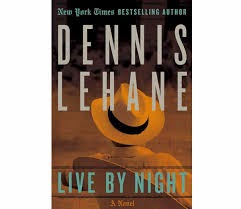
Live by Night, by Dennis Lehane

Dennis Lehane has written many novels, several of which have been successfully filmed.  He centres his stories mainly in Boston, Massachusetts and has always created great characters and great plots.  ‘Live by Night’ is a loose sequel to ‘The Given Day’, an epic tale of the First World War, the soldiers who returned and the police force they joined.  Racism and Baseball play a huge part in this fine book and it would be an advantage for the reader to read this first, if possible, but ‘Live by Night’ can stand alone on its own merits.
Joe Coughlin is twenty years old when this story begins.  He is the youngest son of one of the most respected and prosperous senior police officers in the city of Boston, and he hates his father. His two older brothers have long since fallen out with their martinet parent and left home;  his mother has died, and Joe has happily turned to a life of crime – partly to spite his old man, but also because he likes it.  He doesn’t class himself as a gangster;  he’s an outlaw, a euphemism which has a better ring to it;  it’s 1926, Prohibition is in full swing and there are myriad opportunities to make piles of money from this absurd law as a bootlegger for speakeasies: Joe is thrilled with his circumstances and feels even better that his father, who knows everything that transpires in Boston, is aware that he has a successful criminal – sorry, outlaw – for a son.
Yep, Joe is a is a Twelve O’Clock Fella in a Nine O’Clock Town;  he lives by night, and the night has even more appeal when he meets Flora Gould, a very shady young lady whose hunger for thrills matches his own.  Unfortunately, she is the mistress of a real gangster called Albert White.  Albert is averse to sharing his mistress with Joe and in short order Joe’s life turns sour:  through a series of  unfortunate events he endures a terrible beating, hospitalisation, the loss of his great love and an eventual stint in prison, the sentence of which is reduced thanks to his father calling in some favours.
Like it or not, Joe  should now be repenting at leisure.  His father Thomas, despite his supposed neglect of his youngest has sacrificed his promotion to help his boy survive in prison with a shorter sentence;  all that matters to him now is that his son come out of the dreaded Charlestown Penitentiary alive.  Joe, far from repenting (he’s only sorry that he got caught) devotes his energies and considerable intelligence to surviving attacks from within – and without, eventually forming a long-term alliance with a mafia man, Maso Pescatore.  Ah, the road to Hell takes many forms, and Joe’s journey covers a lot of ground before the eventual showdown and fight to the death:  this is a classic tale of winning it all but losing everything in the process, and Mr Lehane tells it beautifully.  He is a master of suspense and snappy dialogue;  his research is impeccable;  he creates atmosphere and times without any discernible effort and I defy any reader to finish any of his books, then decide not to read another one.  Highly recommended.

The Same Sky, by Amanda Eyre Ward

            Two protagonists take turns to narrate this story;  the first, Carla, is a young Honduran child of eight who lives in extreme poverty with her grandmother and her two much younger twin brothers.  Her mother, in an attempt to make a better life for her family has managed to make the hazardous journey to America, land of gold-paved dreams;  she will eventually send for them all when she saves up enough money from her job at Texas Chicken.
            Alice is a Colorado girl transplanted to Texas after she meets and marries Jake, whose family own a long-established BBQ restaurant.  Her life would be excellent except for the tragic fact that she cannot have a child, thanks to cancer and subsequent doses of chemotherapy.  Jake and Alice’s forays into surrogacy and/or adoption have also failed, and they are resigning themselves with reluctance and sorrow to the fact that their family will only ever consist of themselves.  Alice is not always a likeable character;  she is disagreeable, contrary and downright mean from time to time, especially when she sees Jake’s acceptance of their situation as capitulation:  where is his gumption, his spine, the ‘never-say-die’ attitude that she possesses in abundance?  She is contemptuous of his resignation, and embarks on several new attempts (all unrewarding) to satisfy her thwarted maternal instincts.
            Carla, meanwhile, has suffered tragedy:  firstly, her mother saved enough money for just one of her children to come to her in Texas;  the woman who is delivering the child opts for the ‘quiet one’, twin Carlos who has always been a steadying influence on Junior, his sibling.  Junior is bereft and does not take the separation well;  worst of all, Carla’s beloved grandmother, their island in a sea of poverty and desperation, dies after a short illness.  Carla and Junior are alone.
            Carla’s attempts to find a child’s solutions to her terrible adult problems are portrayed with agonising and brutal clarity by Ms Ward, who spares the reader nothing but the harsh, brutal truth of poverty and such degradation that countless migrants will do anything, including risk death, to Ride atop the Beast, the train that travels from Honduras to Mexico, there (if they are still alive – and lucky) to swim or ride with ‘coyotes’ across the Rio Grande into Texas without being caught by border guards.
            By comparison Alice’s life seems breezy and uncomplicated;  she is loved (most of the time -  she’s prickly);  she and Jake have built the BBQ restaurant into a thriving business;  her family in Colorado have produced three nephews for her to love – but it is not enough:  she will always want more.  She will always want a child.
            Ms Ward unites her two characters fleetingly at the end of this wonderful story, for Carla eventually makes the journey to Texas after suffering unspeakable torments on the way, only to realise that The American Dream is just that;  a dream that hides a reality of drudgery and second-class treatment.  Reuniting with her mother has not been the rapturous experience that she has always longed for;  instead her mother and Carlos hold her responsible for Junior’s absence.  She is now twelve years old.
            In today’s world cruelty, evil and poverty in many countries is the terrible norm, and no writer in my experience has produced work more affecting and poignant, harsh and brutal, as Carla and Alice’s story.  By the very simplicity of her prose, Ms Ward conveys life under the same sky as it is for so many, and as it could be for a very few.  Most highly recommended.

A Song of Shadows, by John Connolly

In ‘The Wolf in Winter’, John Connolly’s last opus (reviewed November, 2014 see below) an attempt was made on the life of Charlie Parker, dark hero of most of Mr Connolly’s books.  He was grievously wounded, but with a choice he made whilst hovering between life and death, and the spiritual support (literally) of his murdered daughter (it pays to have read the preceding books), Charlie decides to give life one more chance.  With the devoted assistance of Louis and Angel, hired killers par excellence he rents a house in a little village on the Maine coast, there to try to regain his former strength and dexterity.
It is a long, painful road back to recovery.  Charlie is not used to the weakness and agony his many injuries cause him but he is determined to get better:  he made the decision to live, now that is exactly what he plans to do.
He is delighted to have a visit from his daughter Samantha, his child by his ex-lover Rachel, and it gives him pleasure to have found a playmate for her;  his beach side neighbour, Ruth Winter has a little girl Amanda who, despite health problems that keep her away from school a lot, welcomes Sam’s company:  from a social perspective life is good.
Until a body is found on a nearby beach, and it is eventually established that it wasn’t a drowning or a suicide, but murder;  at the same time a family has been found murdered in their burning house and the Maine police are swamped with crimes for which they are badly under-resourced.  Tragically, these crimes pale into insignificance when Ruth Winter is cruelly murdered on the night of Sam and Amanda’s playdate, but the most uncanny event for Charlie Parker is that his daughter wakes him to tell him that a man is trying to enter Ms Winter’s home.  How could she know?
Charlie is injured trying to apprehend the murderer on the dunes and it seems that finally his own life is about to end – until Sam (who was under strict instructions to stay in her bedroom) appears at his side to confront the killer – who succumbs to burial under a massive fall of sand, an occurrence that hasn’t happened for decades at that part of the beach .To say that Sam is no ordinary little girl is an understatement.
It is time for Charlie, with the assistance of Louis and Angel, to return to what he is best at:  investigating murder and stamping out evil – if he can, and the deeper he delves into Ruth’s killing, unspeakable old crimes and pure evil finally reveal themselves, for Ruth, a Jew, was killed so that she would not disclose anything she may have inadverdently learned about old Nazis:  Nazi war criminals who entered the United States from Argentina under assumed identities, several of whom settled in Maine.  None wish to be exposed and sent back to Germany, and they will go to any lengths, including multiple murders, to stay where they are.
Charlie Parker is a different person now, after his close brush with death.  There is an implacability, a hardness and resolve about him that cause his loyal friends much disquiet but they are determined – as always – to support him to the hilt in his efforts to purge evil.  Charlie is unfazed by the fact that the battle may be uneven;  what nearly stops his heart is the knowledge that his daughter Sam is just as committed as he to stamp out the enemies of the world, and he is fully aware that she is in just as much danger.
As always, Mr Connolly leaves his readers in terrible suspense right to the last page -  which only poses more questions and enables this beautifully written series to continue.  What a master he is, and what a pleasure it is to read a Charlie Parker book.  Highly recommended.  


The Wolf in Winter, by John Connolly

The town of Prosperous, Maine lives up to its name.  Founded in the eighteenth century by persecuted religious fugitives from England, the settlement grew and gradually flourished, whilst still retaining quaint old buildings (why, they even brought their own church with them to assemble, brick by brick!) and  customs.  The town is still governed by a hereditary council of Selectmen, all descendants of the original inhabitants and, while displaying courtesy to all who come to visit such a picturesque place, it will be eventually noticed that Prosperous does not welcome new people to live within its limits:  Prosperous keeps to itself.
            Until the apparent suicide of Jude, a homeless man who visited the town searching for his daughter, brings private detective Charlie Parker looking for answers:  while it is hardly unusual that a man of the streets would want to end his life, the method of death feels wrong, especially when Charlie checks into Jude’s movements in the days before his death.  Jude had helped Charlie in the past;  it is now up to Charlie to do the right thing.  If Jude’s death was indeed suicide, was it because of his daughter?  Is she dead, too?  And if so, why?  How?
Yet again, Mr Connolly draws the reader into the web of Charlie’s latest dark adventure.  In modern Man of Sorrows Charlie Parker and his two murderous sidekicks Louis and Angel, Mr Connolly has created three unforgettable protagonists – and their enemies are legion, especially The Collector, a self-appointed avenging angel of righteousness, dedicated to ridding the world of those so evil that no lawful punishment is fitting enough. 
Charlie, Angel and Louis have undergone more than one baptism of fire in preceding books to seal their bonds of friendship and loyalty, but when they face the chilling mystery that is Prosperous, one of their number is so grievously wounded that, even as this great book comes to a close it is impossible to guess if he will survive, let alone appear in a sequel.
I take my hat off to Mr Connolly, first of all in praise of his wonderful literary skills:  there are many writers who tell great stories but there are few who write with such clarity and elegance.  And it takes a rare talent to make the supernatural element of every Charlie Parker story so credible, and all the supporting characters so real that they are itching to step off the page and do us harm.
That said, how long will it take Mr Connolly to produce his next book – will there be a next book, with the life of one of the Three Dark Musketeers hanging in the balance?  It’s a big worry, one that I hope will be removed soon.
In his acknowledgements at the conclusion of ‘The Wolf in Winter’, Mr Connolly thanks his readers for continuing to read ‘these odd little books’.
As if we could stop.  AS IF!!  Highly recommended.