Saturday, 29 April 2023


Mrs. Jewell and the wreck of the General Grant.


In May of 1866, the General Grant, ‘ a fine three-master sailing out of Boston,’ was wrecked with huge loss of life off the Sub-Antarctic Auckland Islands in the Southern Ocean, 465 kilometres from the southernmost tip of New Zealand.  Only fifteen of the eighty-three people aboard survived, and despite many searches over the intervening one hundred and fifty seven years, the wreck has never been found.  The General Grant was on its way to England, taking families back to their homes, some with considerable fortunes from the Australian Gold fields, not to mention a big, secret cache of gold from the London, a ship that had foundered.  Newly-weds Mary and Joseph Jewell are passengers, their clothes considerably weighed down by the gold that Mary has sewn into the seams and pockets.  When the nuggets are exchanged for pounds they will have enough to buy a farm in Clovelly, Joseph’s birthplace.  The future looks rosy.

            Until fog and swells push them off course and the worst happens – Mary wasn’t the only one to think of sewing gold into pouches and pockets:  when the ship starts to sink the weight of the gold drags many down to a watery death, and the children – the children have no chance.  The deaths of those innocents will remain in Mary’s nightmares for the rest of her life.  And she will never know why she survived along with fourteen others out of a complement of eighty-three:  fate was either being kind, or looking for her to play with.

            Christina Sanders brings the great tragedy to superb, terrible reality.  Narrated by Mary, it is though we are reading her journal over her shoulder as she writes, especially when she recounts their initial attempts to light a fire so that they wouldn’t die of the cold:  five of their six matches were damp and wouldn’t ignite;  the sixth match was carefully dried by the heat of the owner’s body, and when that last match took, everyone’s faith in God was renewed – until the next crisis. 

            No-one had any idea how long it would take for another ship to sail past, and to their horror, despite their permanent bonfires blazing on high ground, one did do just that – sail past and keep on going.  All hope disappeared for a time after that episode, but it didn’t die completely, especially with the discovery of wild pigs and goats, which made a great change from seal blubber.  There is much to be said of the resilience of the human spirit, and Ms Sanders tells this epic true story with grace and reverence for man’s survival instinct.    SIX STARS.   

Saturday, 22 April 2023


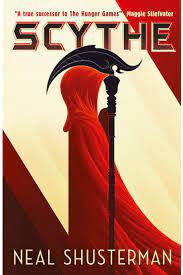
Scythe, by Neal Shusterman.                  Young Adults.


       This is not a recent publication, but it is the first book of a trilogy that I absolutely HAVE to finish.  Dystopian fiction, especially for Young Adults, is now a popular genre, especially with the advent of ‘The Hunger Games’ and it is a fitting reflection of the current turmoil and uncertainty that rules our world.  In ‘Scythe’, Neal Shusterman takes us on an all-too-realistic journey into the near future, where mankind has evolved far enough to have eliminated war, disease, hunger and its attendant misery:  no-one dies any more because all the usual ways to die have been eliminated;  instead, on a percentage basis according to Old World statistics, people are visited by a Scythe, a person specifically selected to kill them – whether they want to die or not.  There is no argument.  It shall be done, regardless of the protests and sometimes rebellion from the chosen one’s family:  it is their time.  Whether they agree or not.

            Scythe Faraday has taken on two new apprentices, even though it is usual to train only one at a time, but he is impressed with both of them for differing reasons:  Rowan happened to be nearby when his high-school classmate was ‘called’ into the Principal’s Office.  He was shocked to witness the boy’s death (called Gleaning), even though he tried to intervene it wasn’t ‘his time’.  He was trying to compose something empathetic to tell the boy’s parents when he is horrified to find his parents have been visited by Scythe Faraday:  if they will apprentice Rowan to the Scythe, then they will have immunity from death too – for a year.  Bye, Rowan!

            Citra, a pupil at the same high school, has also been chosen for her fearlessness at standing up to Scythe Faraday when he visited her family’s apartment, requesting dinner as he waited for their neighbour to come home.  (Scythes customarily eat wherever and whenever they like, for free.  Who would be brave enough to charge them?)  She had so many scathing things to say to him that he admired her courage.  Now, look where that has got her!  And one thing that unites Rowan and Citra irrevocably:  neither of them want to kill anyone, much less learn the myriad ways of death that Scythe Faraday wants to teach them.  It’s great that they have earned immunity for their families (for one year), but at what cost to themselves?

            Neal Shusterman has constructed a chillingly real future world, cleverly combining the former glories of Old World History with a frightening shift in the moral compass of the New.  Let’s hope he’ll never be right!  FIVE STARS.       


Wednesday, 12 April 2023


 The Dead of Winter, by Stuart MacBride.


          Detective Constable Edward Reekie is wondering why he ever became a Police Officer, especially when he is doing all the driving through unrelenting winter snowfall to a remote Scottish village to deliver an old crim on his last legs – and from  the sound of him, his last lung: he’s also transporting his ungrateful and surly temporary boss, Detective Inspector Victoria Montgomery-Porter, who hopes to get a deathbed confession from said old crim Marky Bishop about various places that he has stashed money from his many bank heists.

            ‘Good luck with that, Bigtoria’ thinks her chauffeur unkindly.  He is not looking forward to Glenfarach, their destination;  it’s literally full of felons, a kind of a Last Stop before they kiss their evil backsides goodbye.  It’s a dumping ground for Scotland’s worst paedos, rapists, murderers and sickos, the kind whom ordinary people don’t want in their neighbourhood, and will set fire to their accommodation to drive them out, so the authorities have come up with the ideal solution:  convert an abandoned country estate into a mini-open prison, staffed by Police Scotland’s finest.

            All very well and good, except that driving conditions are frightening and Edward is having a hard time keeping their piece-of-shite squad car on the road, and his nasty intolerant boss is demanding more speed.  The only thing Edward can do is say ‘Yes, Gov’, and hope that the need for speed won’t see them all dead in a ditch, or wrapped in a loving embrace with a Scottish Pine.

            The nightmare trip doesn’t end at their destination;  shortly after their arrival, the first murder occurs, that of a child-molester whom the ‘ordinary’ crims despise, then despite the continuing unrelenting snowstorm, someone unknown (well, of course!) sets fire to the child-molester’s house, destroying all forensic evidence, including his body, which had been most cruelly tortured.  Bigtoria is beside herself, not only because everything has gone up in smoke, but because all the technology has gone on the blink, not to mention ordinary power:  they are literally functioning in the dark.  And it also means that reinforcements won’t arrive from the nearest police centre until the weather dies down.  How is any one supposed to police efficiently in such conditions?  Which are only exacerbated by the next almost identical killing.

            Stuart MacBride never disappoints:  he creates wonderfully credible characters, and in this stand-alone story he has woven so many twists and turns into the narrative that I could only gape at his cleverness.  And it’s all done – not with mirrors – but a fantastic humour and feel for dialogue that has always made each of his books a pleasure to read.  FIVE STARS.    


Monday, 3 April 2023


Dark Music, by David Lagercrantz.


          Swedish writer David Lagercrantz is internationally known for creating well-written and credible sequels to the late Stieg Larsson’s ‘Girl with the Dragon Tattoo’ series after that author’s premature death from a heart attack;  now he has used terrible historic events of the beginning of this century as the background to the brutal murder of Jamal Kabir, an Afghani refugee in Stockholm – and he introduces as his main protagonists his modern version of Sherlock Holmes and Dr Watson to solve the crime.

            Holmes played the violin:  his modern-day equivalent, Professor Hans Rekke, was a concert pianist of some renown.  Holmes has frighteningly brilliant deductive powers, as does Rekke, but Holmes liked his opium pipe, and Rekke has his very own drug-dealer Freddie to supply him with whatever he needs.  Holmes was sad and solitary, and Rekke is bipolar, prone to fits of manic energy or abysmal despair. 

Lagercrantz’s version of Watson, that shrewd, loyal and trusty sidekick, is Micaela Vargas, from a Chilean refugee family who is a new and inexperienced police officer seconded to the Kabir killing.  She comes from a tough suburb of Stockholm and has a couple of brothers on the wrong side of the law;  naturally, they are not keen on her choice of work but too bad:  she loves her job and she’s good at it.  Especially when she meets Rekke and observes his marvellous logic in action – after he recovers from a suicide attempt, rescued by her!  And after he recovers sufficiently enough to use his mind for more positive and productive reasoning, Rekke and Micaela realise that there is a lot more to Kabir’s murder than they could ever have imagined, including the sinister influence of The Good Guys – the American CIA, who are anything BUT, in regard to this crime 

Throughout the whole story is a musical theme, that of thwarted ambition: Kabir in his youth had dreams of being an orchestral conductor, but  the forbidding by the Taliban after the Russians left Afghanistan of all musical forms (particularly decadent western classical music), and the destruction of all instruments used to produce it –‘because it leads us away from the only beauty that means anything, the love of Allah’ stifled any such dreams, and at the time of his murder he was a garage mechanic – and a part-time football referee.  And CIA informer.

Mr Lagercrantz has given us two worthy modern-day successors to Holmes and Watson and the plot fairly sizzles along, especially in the later stages, but I have to say that Ms Vargas had a two-dimensional air about her initially – which could have been translation problems. Anyway, I look forward with great anticipation to their next adventures.  FOUR STARS.     

Sunday, 26 March 2023

Act of Oblivion, by Robert Harris.


The execution of King Charles the First on January 30th, 1649 was the highlight of the English Civil War between the Royalists (Cavaliers) and Parliamentarians (Roundheads); a great victory for the Puritans led by Oliver Cromwell against Godless, dissolute voluptuaries, all Catholics to a man, slaves to Popish Rome.  England was finally to be a republic, ruled by the English.  For a time.

            Internationally famous author Robert Harris, who has covered just about every world-changing epoch in history, has now turned his attention to the turbulence and tragedy of England after the ascension of Charles 2nd, and the newly founded Puritan States in the great, unknown and largely undiscovered land of America.  And what is hugely notable about Mr Harris’s recreation is that every character – with the exception of The Manhunter – is authentic;  each person has a recorded existence.  Which is not to say that there wasn’t a manhunter:  as Mr Harris says, there had to be a man who mercilessly tracked down each man responsible for signing Charles the First’s death warrant.  When Royalty was restored anyone who had not fled to Europe or the American Colonies was rounded up, flung in the Tower and hung, drawn and quartered in front of the masses on a well-advertised date.

            And those who were in Europe were tricked into coming out of hiding at the prospect of fictitious meetings with their beloved families, only to find that Richard Nayler, The Manhunter, had tricked them:  they were all going to die by the cruellest death imaginable: ‘to be hanged until the point of unconsciousness, cut down, revived, castrated, disembowelled – the entrails dragged out and burned in front of the living victim – then beheaded and his body cut into four quarters for public display’.

 Nayler is very pleased with his tally of Regicides so far, but two men have continually escaped him by fleeing very speedily on one of the first ships after the punishments were announced, to the Puritan Colony of New England,  on the East Coast of North America.  Despite one fruitless trip to America where his prey, Puritan Colonels Edward Whalley and William Goffe successfully eluded him, Nayler has not forgotten them, for their righteous cruelty resulted in the loss of his loved ones:  he will stop at nothing to see them dead, for as we all know, revenge is a dish best served cold.

Mr Harris is an enormously competent writer, bringing to life beautifully the lives and times of characters great and small, and his descriptions of the great, hospitable, perfect new land and its indigenous occupants at the mercy of its Colonisers brings a lump to one’s throat today, three hundred and sixty years later:  Man, the wrecker.  FIVE STARS.  


Thursday, 16 March 2023


The Light in Hidden Places, by Sharon Cameron.             Young Adults


Countless books have been written on the Second World War, and everyone knows of the atrocities committed by thousands in thrall to Hitler and his Third Reich and his attempts to eradicate every Jew from the face of the earth.  It is common knowledge, too, that more than six million people were ‘exterminated’ because of their racial impurity, their inferiority to all right-thinking Aryans.  Gott im Himmel:  Hitler was trying to do the world a favour!

            But some still clung to the irritating Old Ways, not bothered by the fact that Jews followed Moses as Catholics followed Jesus Christ, and such a one is Polish teenager Stefania Podgorska, who starts her first job in the grocery shop of a Jewish family, the Diamants.  Stefania, nicknamed ‘Fusia’ lodges with her sisters who work in Przemysl and she’s thrilled to be away from the farm, and her mother – the freedom is intoxicating!  And her acceptance into the Diamant family is complete;  she is their new little sister – differing religions are easily accommodated, and all is well.  Until the Germans bomb Przemysl and turn up in person days later with all their weaponry.  And cruelty.  All Jews are rounded up, their businesses closed and apartments ‘given’ to Christians.  They are herded into a ghetto by the railway station, there to wait for the trains to take them to ‘work camps’.  It doesn’t take long before people find out what happens at the work camps.  Hitler’s campaign of extermination has begun.

            And Fusia is outraged that her second family is dragged off to the Ghetto – by great chance, she and her little sister Helena are able to stay in the Diamant’s apartment and it isn’t long before she hatches a plan to aid the people she most loves, first with food judiciously bought and bartered, then – most audacious of all, to help some of them to escape from the Ghetto and hide them in new, larger accommodation (it has an attic that will take a false wall) that she has found on the other side of the city – which is wonderful!  God and the Blessed Virgin have heard her prayers!  She thinks. Until she is ordered to share her accommodation with two German nurses from the Military hospital across the road, who are unaware that there are thirteen Jews hidden in the attic above.  Natürlich.

            This true story reads like a thriller.  The suspense is palpable, even though we know the outcome for, with the family’s permission, Ms Cameron has written Fusia’s heartbreaking, magnificent story as a novel, which has given it all the drama that a historical account would lack.  Stefania Podgorska is a true heroine, named with her sister Helena as  Righteous Among the Nations by Yad Vashem, the World Holocaust Remembrance Centre, and rightly so, embodying perfect goodness at a time when evil ruled.  SIX STARS.    

Monday, 6 March 2023


Day’s End, by Garry Disher.


Demoted South Australian Detective Paul Hirschhausen has (after three action-packed books) settled satisfactorily into small-town life in Tiverton as the local constable with a huge rural beat;  his patrols around the local farms can take all day – a huge amount of driving, but necessary to establish relationships with those who live in remote areas by choice and/or necessity.  Like rich newcomers Sam and Mia Dryden, who have purchased a huge spread which was the last point of contact between Professor Janne Van Sant and her son Willi, on a backpacking holiday in Australia.  Professor Van Sant has come from Belgium to search for Willi because he has not emailed or phoned;  in fact he has disappeared without trace.  The Dryden property was his last known place of employment:  she needs to know – and see – where he went missing and Hirsch is her escort for the day.

            And all should be well, for the Drydens explain that Willi and his girlfriend just up and left one day as young people do, so sorry, can’t help.  But attached to the gate at the beginning of the long drive is a new notice:


Unvaccinated visitors welcome here.  We refuse to enforce unlawful directions from a government that would microchip its people.


              It would appear that not only are the Drydens anti-vaxxers, but about as Far Right as it’s possible to be, and as Hirsch investigates further into the nasty underbelly of mis-and-disinformation (even the regional police station has ‘believers’!) he is also appalled to find that various criminal acts attributed to a new family of no-hopers in town have shown that they will stop at nothing – even murder – in their efforts to gain a foothold in a sleepier, safer, less-policed place than Adelaide.  Hirsch’s plate of calamity is full!

            But Hirsch’s problems multiply a hundred-fold with the report of the disappearance of a light plane used by local Pete Aronson for his aerial photography business:  he and his plane haven’t been seen for twenty-four hours.  Something is wrong, and when the downed plane is finally found, crashed and burned-out, Pete’s incinerated remains are found in the tiny cockpit.  An accident?  Maybe – until bullet holes are found:  Pete’s little plane has been shot out of the sky.  What did he see that cost him his life?

            As always, Garry Disher does a wonderfully competent job of keeping up the suspense, and he portrays with his great characters the sorry state that the world Post-Covid is in at the moment – I say at the moment because I hope against hope that previously rational, reasonable, logically-thinking people will eventually stop believing nasty fairy tales and start living without fear again.  I hope.  FIVE STARS.