Saturday, 27 October 2012


MORE GREAT READS FOR OCTOBER
Feast Day of Fools, by James Lee Burke
So.  I have to ask myself the question:  what rock have I been hiding under all these years that I could remain uninterested in a superlative writer who has now completed thirty thrillers?  Because I thought he was probably the same as all the other formulaic writers, that’s why.  Well, shame on me.
James Lee Burke’s literary reputation is so secure that he hardly needs an endorsement from a Library blog in New Zealand, but that won’t stop me from singing his praises all the same.  I’m just vexed at myself for not reading his books sooner.  Fortunately, ‘Feast Day of Fools’ despite being the latest in a series of stories about Texas sheriff Hackberry Holland  (yep, that’s truly his name),  is easily read as a stand-alone novel, for Mr Burke’s skill is such that he can bring the first-time reader (me!) up to speed with action from previous books,  introducing it so seamlessly that I never felt mad as I usually do, for approaching the series from the wrong end.
Sheriff Holland is an old man now, nursing much sorrow and many regrets, but still functioning superbly as the guardian of the law in a small West Texas town close to the Mexican border.  He has a loyal staff consisting of  deputies Pam Tibbs, whose devotion is a thin disguise for the great love she feels for him; and  R.C. Givens, whose frail-looking physique belies his resourcefulness and intelligence -  and let us not forget switchboard operator Maydeen Stolz, whose vulgarity offends the Sheriff daily.
Crime in the area is usually connected with the Wetbacks, those hapless Mexicans who cross the Rio Grande, then pay ‘Coyotes’, unscrupulous guides, to help them find menial work in Texas.  They are illegal aliens, willing to do anything to make a living, for compared to their miserable lives in Mexico the United States is still the Promised Land.  However, when the remains of a tortured man are found by a local alcoholic and reported to the sheriff, a chain of events is started that leads not just to wets and coyotes, but to defence contractors and organised crime, an ex-C.I.A operative and the shadowy pursuers of them all, the F.B.I.
Oh, everyone gets a mention in Mr Burke’s complicated plot and there are baddies of truly Olympian proportions, but Hackberry’s true nemesis from previous encounters is Preacher Jack Collins, a messianic, scripture-quoting killer whose favourite weapon is a machine gun.  Preacher Jack is a one-stop-shop of high intelligence, hatred, malice and forward planning, and he and the sheriff have unfinished business to conduct:  every now and then Jack rings Hackberry to remind him, to keep him on the back foot – and these little exchanges are gems.  Mr Burke writes scintillating, witty dialogue, so good that despite the fact that some of the characters reach caricature proportions, they are continually redeemed by their folksy, down to earth humour and logic. 
Sadly, logic is jettisoned in the last chapter of this otherwise fine story:  after a gun battle that should have left no-one alive, Hackberry and his allies march off into the desert and imminent rescue, even though they are all leaking gallons of blood and shouldn’t be able to walk a single step.  That’s stretching the reader’s credulity to snapping point!
But let us not forget Mr Burke’s wonderful descriptions of the natural world around him:  he populates his stark and beautiful landscapes with roiling purple clouds, fiery sunsets and the vastness of desert spaces.  Until I read this book I didn’t know a butte from a banana or a mesa from my elbow but I’m happy to say that I NOW HAVE THE PICTURE, thanks to Mr. Burke’s marvellous imagery.  He has the singular ability to make the reader examine crime in all its guises, too -  not just the who-done-it variety, but the greater crimes that start wars, the terrible crimes that wars unleash, and the criminals who set it all in motion.  Highly recommended.

Billy Lynn’s Long Halftime Walk, by Ben Fountain
This is a five-star story.  It ably illustrates many of the things I said about war in the last paragraph of the above review, this time from the perspective of the last, most unfortunate link in the chain:  the soldier who must kill or be killed in order to ‘win the War on Terror’ – to ‘Keep Our Country Free’, and to ‘Kill Them before they Kill Us.’
The myriad reasons for the War in Iraq are baldly displayed here, and it’s up to the reader to decide what opinion to have, but it’s obvious that Ben Fountain (at least in this book) is no friend of the Bush administration.  The sending of  invading troops to Iraq ostensibly to search for the mythical ‘Weapons of Mass Destruction’ is nothing more than a cover-up to gain eventual control of the oil supply – that’s what the surviving members of Bravo squad think, but they signed up (for all sorts of different reasons); they’re in it for the long haul, and they’ll fight.  That is what they have been trained to do;  it’s their job;  and they’ll do it until the end – either the end of their service, or the end of their lives.
One such soldier is Billy Lynn:  he’s nineteen years old and was given the choice of the army or jail when he was eighteen.  He trashed his beloved sister’s pussy-boyfriend’s ‘pussy car Saab’ because the pussy dropped her three weeks after she had a near-fatal accident.  Billy chose the army and, after Basic training was sent to Iraq to join Bravo squad, a time of crushing boredom, alleviated only by the huge fear everyone felt on going on patrol, an exercise ordered almost more often than they can stand by Staff-Sergeants Dime and Shroom, firm friends who served together in Afghanistan:  these men understand all too well how important it is to face and conquer the fear.  Eventually, the squad’s mettle is tested in a blazing firefight with insurgents: two of their number die but the insurgents are wiped out and the whole bloody conflagration is filmed by a Fox crew embedded with Bravo;  the three-minute film clip goes viral, becomes a YouTube sensation, and before anyone can say ‘Cheney and Halliburton’ the survivors of Bravo squad are brought back to the States for a two week victory tour after receiving medals for bravery from President Bush at the White House.
The men are intelligent enough to know that they are the Poster Boys for a huge propaganda drive to keep Americans’ hope and patriotism alive after years of The War on Terror, which seems to have slowed considerably in momentum lately – but who cares?  To sleep in a clean bed again, to not have to fight king-size insects for food and bedspace – and to see all those fine women again:  oh, those dudes are in HEAVEN.
And even better still:  a movie producer has joined the tour.  He’s a high-powered, fast-talking dealmaker with a mighty reputation, and he wants to make a film of the Bravos, with big-name stars playing them;  big names are quoted constantly (Billy is dismayed to hear that Hilary Swank is interested in playing him.  HUH???) and the magical figure of one hundred thousand dollars is quoted as a payment to each Bravo for the rights to his character.  The future – if they all survive, for they are to be sent back to Iraq when the tour is over – looks rosy indeed.  And if they don’t survive, why their wives and mommas will have a nest-egg!  They think.
Most of the action of this great story occurs on the last day of their tour;  the Bravos are the guests of honour at Texas Stadium for a huge Thanksgiving Day football match between the Dallas Cowboys and the Chicago Bears:  they meet the Cheerleaders!  (Billy falls instantly in love with one)  They meet the football team!  (Behemoths to a man.)  They meet the owner and his fabulously rich pals!  (And their plastic fantastic wives.)  And they are turned into a support act to Destiny’s Child! -  the halftime high-end musical attraction, an experience none of their training  has prepared them for.
And they realise, belatedly, that the bravery for which they are so loudly and publicly praised means nothing when confronted with Big Money and the Art of the Deal:  heroes are there to be screwed, just like everyone else.  Disillusioned, weary and disgusted with their brush with fame, the Bravos and Billy prepare to go back to war, no longer convinced that they are fighting for high ideals, but firm in their conviction that they will fight to the death – for each other.  ‘We happy few, we Band of Brothers’.  Shakespeare, as always, had it right, and so does Ben Fountain:  he has written a wonderful book, a darkly humorous, ruthlessly honest portrayal of a great nation under siege, hostage to The War on Terror and Nine Eleven, and the way that its politicians, citizens – and soldiers faced the threat.  This is a must-read – don’t miss it.      

Sunday, 14 October 2012


GREAT READS FOR OCTOBER 2012
Sarah Thornhill, by Kate Grenville
Sarah Thornhill is the youngest daughter of a prosperous former boatman and convict, ‘sent out’ from England in 1806 for a crime he has always refused to divulge.  After his sentence was served he was able to disappear into the remoteness of the Colony of New South Wales, claiming land enough to establish himself on the Hawkesbury river and with his canniness and eventual wealth still the tongues of his neighbours, who have not been ‘sent out’ and don’t wear the taint of the Broad Arrow.
Sarah narrates her own story in bold, forthright and deceptively simple prose;  she is illiterate like the rest of her family and, like the rest of her family, sees no need to learn her letters – Pa never learnt and beat adversity, so why should they?  She has very few memories of her mother who died when she was very small:  instead she is raised by Ma, Pa Thornhill’s second wife and a force to be reckoned with. Ma has ironclad ideas of good behaviour and etiquette and all her stepchildren have to conform – even Pa appears acquiescent to her absolute authority:  therefore it is up to Sarah to be the rebellious thorn in her Ma and Pa’s side.  And she does it by falling completely in love with Jack Langland, strapping, staunch and handsome half-caste son of a close neighbour.
Jack is the product of the union between his father and an aboriginal woman.  He has been raised ‘White’, but when push comes to shove, when Sarah and he publicly declare their intentions, the hornet’s nest is disturbed and out come all the hidden hatreds and prejudices, the scorn and contempt for the original inhabitants of that vast and ancient land, and the unshakeable convictions of white superiority, especially over a ‘black buck’, formerly regarded as a sound fellow until he aspires to be a potential bridegroom and son-in-law.  Sarah has to face many hard truths and much tragedy as she tries to make sense of the injustice of her young life, and the thwarting of all that she sees as the natural and proper direction of her future;  the choices she makes are forced on her and are at the core of this wonderful story.  Ms Grenville is one of Australia’s foremost and respected writers  and evokes in breathtaking prose the struggles, drudgery and everyday heroism of the early settlers, Untainted and Convict alike, but still possessed of  a racism born of ignorance, malice and fear:  as Sarah carries on with her life, she discovers horrific and ugly family secrets that alter forever her perception of her world, and everyone she knows and cherishes within it.  This is a stark and powerful story of injustice and cruelty, kindness and love – just as life is for so many of us, regardless of the era.  Highly recommended.
50 Shades of Grey, by E. L. James
 Your library is ever mindful of the needs of its borrowers.  To that end it has faithfully supplied copies of E. L. James’s trilogy for those who wish to read it, and its popularity is such that some people could die on the waiting list.  Perish the thought, not those on the waiting-list, I say!
When this tale begins, Anastasia Steele is having a bad hair day and doesn’t have a suitable thing to wear for the interview she has been persuaded to do with MegaZillionaire Christian Grey for the student magazine.  Her room-mate, magazine editor Kate, the original interviewer, has the ‘flu.  As if that weren’t tarsome enough, the poor wee thing trips (because she’s accident prone) through the door to the Great Man’s MegaOffice.  As he rescues her from the floor and envelops her in his hot, gray gaze, all the usual things happen:  her heart falters;  she can’t meet his eyes (ah, those eyes, like a threatening sea on a windswept day!) she blushes furiously (she does this A LOT);  she asks her set questions in a monotone – ‘Are you Gay?’ – (all the while agog at his beauty, which frequently invokes bursts of great silent introspection: ‘ Holy Crap,  followed by ‘Holy Shit,’ then finally, ‘Holy F@@##!’).  Yep, she’s a deep thinker, alright.
For his part, MegaZillionaire Christian is undeniably impressed (why?  Anastasia is now redder than the sunset.  She blushes for Africa.) and attracted to the winsome, helpless, clueless interviewer and before one can say WATCH OUT ANA, PERVERT ALERT! he has her in his power.  And he doesn’t even have a moustache to twirl.  Yes, he’s a 21st century cad, a dastard, no doubt about it – BUT! – after their first tumultuous coupling, where he is horrified to find that naïve Ana is that worst kind of innocent, a VIRGIN, she finds him hours later semi-nekkid in his cavernous living room, playing a mournful Bach arrangement on his grand piano sadly but superbly, (of course he is a wonderful musician, because he is excellent in all things) - this proves to readers (and there are so many of us!) that the dastard has a tragic side, a mysterious past which he refuses to reveal, and an aversion to being touched.
Naturally this presents some problems for Ana, who has never had a relationship before (WHAAAAT?!!  In her twenties and never been kissed?  Who is she, Jane Austen?).  She longs to touch him, to trail her fingers through his gorgeous, tousled chest hair, but he refuses.  She is extremely worried that she is ‘falling for a man who’s beyond beautiful, richer than Croesus, and has a Red Room of Pain waiting for me.’  Yep,  I’d be worried, too, but Ana places great faith in two friends:  her subconscious, ever her reliable moral compass, and her Inner Goddess, which is just a euphemism for Ho:  her Inner Goddess wins every time.  That girl is doomed.
And so is the reader (and there are SO many of us!), doomed to absorb the riveting fact that Christian’s eyes blaze when he whups Ana’s ass;  they’re haunted when he plays Bach superbly semi-nekkid, and hooded when he wishes to disguise his true feelings.  He steeples his fingers a lot, too.
Oh, this is a corny, horny, porny story:  it’s so trashy that it should be in a plain brown wrapper – but what power there is in word-of-mouth advertising!  E.L. James will never have to write another rude word;  she can just sit on the millions made from this trilogy like a chook on her eggs, if she wants to.  In the meantime, fans of Anastasia and Christian (and there are so MANY of us!) will press on with books two and three, because despite all the huffing, puffing, painful sex, Ana’s perpetual blushes and Christian’s steely gaze or wicked grins, we all have to know WHAT HAPPENS NEXT. 
When all is said and done, I must confess that I would rather go to bed with a good book than a fruitloop in a suit, but there’s no accounting for taste.  And there’s nowt so queer as folk as we all succumb to the lure of a worldwide best-seller, purely because everyone is saying:  ‘Have you read it yet?’
Read this torrid, tortured tale (if you haven’t already).  I think this is a Gross Read for Great Readers, but you be the judge.
                 

Sunday, 30 September 2012


DEFINITELY THE LAST GREAT READ FOR SEPTEMBER!
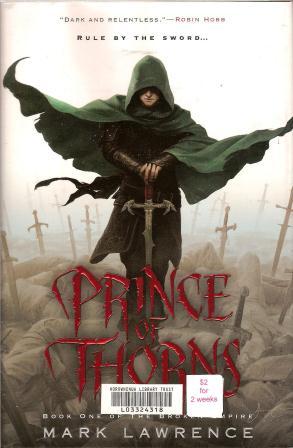
Prince of Thorns, by Mark Lawrence
You read it here first:  What an adventure!  Mark Lawrence’s debut novel has all the requisite ingredients for the ideal fantasy – a wronged and vengeful hero, warring kingdoms, ghosts, necromancers, murders most foul, and a complete lack of honour, except amongst thieves.
At the tender age of nine, Prince Honorous Jorg Ancrath was forced to witness the slaughter of his mother and younger brother William by Count Renar of the Highlands and his troops.  If he expected his father the king to avenge their dreadful murders, he is sorely disappointed;  instead, the king negotiates compensation in the shape of land and horses for his loss.  Seeds of hatred and revenge are sown in the fertile ground of Jorg’s grief and heartbreak:  he takes to the road and joins a band of mercenaries and outlaws, and because he no longer cares if he lives or dies, he becomes their leader through sheer recklessness and a bravado that is fearless and suicidal – oh, Jorg has problems, alright – he has already lived five lifetimes and he’s only fourteen!
Mark Lawrence has created a rip-roaring, no-holds-barred, heart-in-the-mouth pageturner in this first book, and in spite of the reader knowing they shouldn’t believe a word of it, they are totally sucked in, swept along with the clever plot and more action than a body should rightly have to endure – oh, it’s great stuff, and this is just the first book of a Trilogy.  ‘King of Thorns’ is next, and a fascinating question for the reader is to figure out exactly the timeline in which Mr Lawrence has set his stories:  a vastly altered central Europe might  be the setting, but who can be sure?  Everyone fights in armour with medieval weapons, but Jorg wears a wrist-watch!  (which doesn’t make an appearance till book two) – and he lets loose what seems suspiciously like a nuclear explosion halfway through book one.  I have come to the conclusion (I’m ashamed to say it took me a while) that Jorg’s story is set far into the future:  it’s possible that the world we knew has been destroyed for whatever terrible reason, and the regenerating human race hasn’t progressed beyond another Medieval Age in its attempts to survive.
Which all adds to this trilogy’s great appeal.  ‘ Prince of Thorns’ was a gripping read, but book two, ‘King of Thorns’ is even better.  Roll out book three!  Mark Lawrence isn’t just a good storyteller – he’s a great one.  Whatever I read next, this will be a hard act to follow.     

Monday, 24 September 2012


MORE GREAT READS FOR SEPTEMBER

Pure, by Timothy Mo
Firstly, apologies for the book cover:  for those who can’t see a thing it is pristinely white, as befits a novel about purity – the irony is that Snooky, its main protagonist and the principal narrator of this complex and brilliant story, is anything but.  She is a tall and strapping Thai ladyboy, drug-addicted, amoral, longing to be a woman but ultimately unwilling to have ‘the operation’.  She (always ‘she’ – the further the reader gets into the story the more her femininity is reinforced) is also a person of strong loyalties and friendships, not only among her ladyboy Sistas but for childhood friends at her local village school in the predominantly Muslim Southern region of Thailand.  She cherishes the friendship of charismatic and wildly popular Jefri, a benison casually bestowed upon her out of sympathy for her situation, she being the family disgrace, an insult to their good and devout name and an object of intense hatred to her older half-brother.  Oh, life was unkind to Snooky and it comes as no surprise that she lit out for the fleshpots of Bangkok as soon as the opportunity arose.
Snooky makes a life for herself;  she learns English well enough to become, of all things, a movie and food critic for a midsize paper – when she is not out clubbing and drugging, whoring and scoring with her trannie friends;  she has a good, close friendship with Avril, a straight Canadian girl, and apart from some new and worrying health problems, life is satisfactorily hedonistic – until.
Until the police raid her flat and take her and the screaming Sistas down to the local station, there to concentrate on beating them all up, but with the object of narrowing the field to Snooky, the real  person of interest.  And the person who is most interested is the sadistic Look Khreung, a Eurasian intelligence officer wishing to infiltrate the Southern Thai Muslim religious schools, or Pondoks, correctly believing that some or all of them are hotbeds of sedition and rebellion.  He needs a spy, a familiar face – suitably roughed-up by his cronies as authentic proof of Thai discrimination against Muslims – to return to the South as a Mole (see, I know my John Le Carré!), especially as the noble Jefri has now excited suspicion for his subversive activities. 
Needless to say, Snooky is not receptive to this suggestion but the alternative is even worse:  twenty years in prison for drug crimes.  What’s a girl to do, except to obey her hated handler who is in turn controlled by an old-school, retired Oxford Don, to whom Snooky is supposed to send encrypted info.
Poor Snooky:  she’s well and truly between a rock and a hard place, and feels even worse when her new Muslim teachers, who despise her otherness, call her Ahmed (her birth-name) and force her to take testosterone so that her beard will grow.  She has reached her nadir – until she realises after a few months of religious study with Shayk, the revered leader of the Pondok, that there can be an alternative to her old life, a just and clean way of living, a purity to her existence and a belonging that she has always yearned for but never previously experienced.  Eventually, the despised ladyboy becomes a valued and resourceful member of the cell.  (She even makes a dreadful propaganda movie!)  For the first time in her life she is truly part of a family – a family bent on the destruction of the infidel.
This book is brilliant:  it’s characters, some of whom have a turn at narrating the story, are masterful creations and Mr Mo gives us a superb overview of South East Asian politics and a deeply disturbing insight into religious fanaticism.  His scholarship is impressive – but daunting:  I have to admit that I floundered amongst the erudite ramblings of Victor Veridian, retired Oxford Don and sometime Spy.  There were references to various world events that flew over my head like sparrows, leaving me feeling more than a little lacking in the smarts department – and the print was so small it made my eyes water.
Regardless, Snooky will remain with me always, that irrepressible, hilarious, doomed and valiant girl, who, despite her worsening illness, decides to arrange a meeting with all her enemies, then go out with a bang – ‘Yah man, because Snooky loves the limelight!’
And rightly so:  she’s unforgettable.

Broken Harbour, by Tana French
Mick Kennedy, one of Dublin’s most successful detectives is assigned to a shocking new murder case:  the killing of an entire family in their recently purchased house at Brianstown, a new seaside estate some distance from the city.  Kennedy is an arrogant man, supremely confident in his ability to ‘get a solve’ because he is so good at what he does – and he is also a straight arrow;  incorruptible:  no easy, manufactured evidence or short-cuts when he’s on the case.
All the signs point to murder/suicide.  The husband lost his job almost as soon as they moved into their dream home;  the dream home turned out to be a jerry-built nightmare amongst many on an estate that quickly ran out of money before all the promises of beautiful new community facilities were met;  the estate was too far to commute to work, should anyone be lucky enough to have a job, for the great Irish recession had wiped out employment like the flick of a dishcloth countrywide – all perfect reasons for the breaking point to be reached and the family to be sent to the hereafter in a last terrible act of togetherness.
Ms French is a powerful writer.  She recounts with effortless ease of the ties of love and loyalty that bind people together – and the awful acts that tear them apart.  As detective Kennedy and his new probationary partner Richie Curran delve deeper into what should have been an open-and-shut case, they find to their dismay that, as with the humble onion, there are many more layers to peel away before they arrive at the awful truth, and many ghosts that must be laid to rest – not least by Mick Kennedy, whose past contains shocking memories of Broken Harbour, now called Brianstown.
This is the third book I have read by Ms French;  once again, she meets the same high standards she sets for herself and that every reader has come to expect in each story:  what a pleasure it is to read her work.  Highly recommended.  


Wednesday, 12 September 2012


GREAT READS FOR SEPTEMBER, 2012
Black Boy, White School, by Brian F. Walker          Young Adult fiction
Anthony (Ant) Jones is an angry young man:  he is angry that at fourteen he is the youngest of three brothers and has to go shopping for groceries (and worse) for his acid-tongued Momma, simply because Andre and Darnell ‘are too old to be bossed around and too big to hit’;  he’s frightened because East Cleveland, Ohio, the city he lives in, is dying from all the diseases that have disabled so many American cities:  closure of long-established industries and consequent unemployment;  civic mismanagement and the apathy and loss of hope by welfare-dependent inhabitants – what will become of them all? 
Fortunately for Ant (not that he thinks so), a scholarship with free tuition for deprived minority kids is available in a top boarding school in Maine, Belton Academy: Ant’s Momma is determined that he will take this unheard of opportunity to better himself, to make a life for himself that won’t end like his friend Mookie’s, dead at 15 in a drive-by shooting.  He has to stop ‘acting ghetto’, seize this chance for a different life through education, and by God, he’s going to do it if she kills him to make him go to Maine!  When his choices are presented to him in such a way, Ant realises he HAS no choice:  he has to go to Belton, or get his Ass broken big-time by his Momma.  She’s still bigger than him.
His first months in Belton are like living on another planet with friendly but remote aliens:  everyone calls him Tony, even though he has stressed numerous times that his name is Ant;  his room-mate, Brody, is a white stoner with racist parents;  everyone assumes for some inexplicable reason that because Ant is black he is from New York as are the few other black students;  and worst of all, there seems to be an accepted practice called ‘hazing’ of freshmen – bullying by another name:  all new boys are tossed into ‘the brook’ by older students as part of ‘initiation rituals’.  Ant decides immediately that no white dude is going to do that to him, particularly when he finds out that the brook in question is actually a toxic waste spill.  Ant has never heard of hazing.  No-one would do that in East Cleveland – ‘back home, it would get someone shot.’
Ant’s solution to his freshman initiation, and his struggles to become accepted and respected in his white environment is a riveting story told with great empathy by Brian Walker, who has recounted through Ant’s experiences his own difficulties at the same age, when he was sent to a similar prestigious school far from all that was familiar to him, all that was family, and all that was ghetto.  He writes from the heart about Ant’s year at Belton, because it was his year too, and his year to return home to find that he was too scared any more to live in that terrible, hopeless environment, especially when another dear friend is murdered.  His desperation is complete when he HAS to leave Belton, which, for all its alien beginnings has provided him with the tools for a new way of looking at the world, because his Momma can no longer afford to pay for the boarding fees and textbooks for his ‘free’ education.  Where does he go from here?  He knows that white society will never be a comfortable fit, but he is too different now just to blend back into his old, sick neighbourhood:  the choices he makes will be his alone, and Brian Walker, by writing this wonderful book, has proved that the Ants of this world can still make the right, courageous decisions.  This was truly a great read.


Gods and Beasts, by Denise Mina
Detective Sergent Alex Morrow is back again in this taut and clever thriller from premier crime writer Denise Mina.  Ms Mina writes of Glasgow and its mean streets and meaner inhabitants with great assurance and skill, drawing the reader effortlessly into Alex’s Jekyll and Hyde world, introducing new characters and giving the existing ones lesser or greater roles as the plot demands.
Brendan Lyons takes his 4 year-old grandson to the post office to buy Christmas stamps;  while they are standing in the queue a gunman bursts through the door to rob the place.  In an act of tremendous bravery, Brendan passes his grandson to the person behind him (‘He’s yours’) then calmly proceeds to help the robber gather the cash, but when that is accomplished, he is shot to death, riddled with bullets by the gunman.  Even more horrifying is the fact that the robber and he knew each other.
Martin Pavel is the young man charged by Brendan with the safekeeping of his precious grandson.  He is a damaged soul, (as are we all) unsure of his place in the world, an inheritor of great wealth but at a loss to know what to do with it:  DS Morrow and her partner Harris are baffled by his presence in Glasgow, and his reluctance to divulge anything about himself;  in fact, the more they delve into Martin and Brendan and his family’s past, the more confusing and labyrinthine the case becomes – especially when the name of a very well-known local politician surfaces in the course of their investigations.  But DS Morrow is nothing if not dogged, determined to weave all the loose threads into a credible pattern that she can believe in. She presses on, only to find that to her horror, information is being withheld – from within:  by her own department.
Ms Mina can evoke atmosphere and construct characters so believable that her word pictures are indelible and have the reader, however disquieted by her no-frills prose, calling for more:  However, having stated the obvious, I  have to say that ‘Gods and Beasts’ is a bleak story, as bleak as the Glasgow weather at Christmas time – there are no happy endings, just respite and escape from tragedy for some of the characters, and the exposure of others to the criminal and corrupt underbelly of organisations they had thought unassailable to the gangster element.  It may be the city of Glasgow is so corrupt that it is irredeemable, unable to be saved - or forsaken - ‘by those who live with self-sufficiency outside the city walls –be they Gods or Beasts’:  regardless, by the time the reader reaches the explosive conclusion of this fine story it is clear that  Alex’s problems are just beginning, but it is a great consolation to know that once again, DS Morrow has won a battle in a long, frustrating and exhausting war.  Highly recommended.

The Sisters Brothers, by Patrick De Witt
It is 1851, and the Gold Rush has started in California:  previously sane and rational men have been struck by Gold Fever, leaving their loved ones and all they hold dear in order to scrabble about in dirt and streams to find the Mother lode,  presenting themselves as perfect victims to all the opportunists who spring from nowhere to exploit them.
Such a person is the Commodore, so enormously rich that he can afford a staff of hired killers to dispose of those who have not obeyed his orders to relinquish their paltry, new-found wealth – or more importantly inventions to him.  His premier killers are Eli and Charlie Sisters, brothers who are justly feared for their utter ruthlessness in carrying out their master’s instructions:  they are not to be trifled with and  older brother Charlie is proud of their reputation as murderers without peer.  Eli is not so sure;  killing people is not a comfortable fit for him and he wants to get out of ‘the business’, but his loyalty to his brother, his feeling that he must be there to protect him – from himself as much as their foe, creates almost unbearable conflict within him.  He is determined that their latest job will be their last, even though Charlie pours scorn on Eli’s distaste for their occupation – it doesn’t worry him either that their mother has banished them from the family home ‘until they change their murdering ways’.  Charlie has a magnificent unconcern for scruples of any kind:  life is for living until you die, by natural means or otherwise.
Their latest assignment from the Commodore is to track down a prospector who has done him wrong, Hermann Kermit Warm by name:  the brothers must travel from Oregon City to San Francisco to find Warm, then dispatch him to his last reward, returning with a secret formula that is of great interest to the Commodore.
So begins the brothers’ last great adventure, an odyssey peopled with some of the most singular characters in contemporary fiction, narrated by Eli with marvellous empathy and humour, and when the brothers aren’t shooting everything that moves they are either festering with sibling rivalry or banding together in brotherly loyalty, particularly in a tight spot.
This novel was shortlisted for last year’s Man Booker Prize and in this reader’s opinion deserved to win it, not only because the actual winner failed to engage me half as successfully as did Patrick de Witt’s perfect little literary gem, but because of the superb depiction of a particularly lawless, dog-eat-dog time in the Old West, and the underlying themes of great good, great evil, and greater forgiveness.  FIVE STARS.

Harbor Nocturne, by Joseph Wambaugh
Joseph Wambaugh first made his considerable reputation as an author of top class crime novels thirty years ago with ‘The New Centurions’, a story of the Los Angeles Police Department and the men and women who went out every day onto the city’s streets to patrol and protect its citizens. ‘Harbor Nocturne’, his latest story, doesn’t deviate from the same theme but concentrates more on Hollywood and the Los Angeles port of San Pedro for its action.
As always, Joseph Wambaugh has produced a page-turner par excellence, at the same time displaying his intimate knowledge of the job and  the many horrors and dangers faced by LA’s finest, for Mr Wambaugh was himself a policeman until he started to write and he still has strong links to law enforcement - which makes me wonder how many of his excellent characters and situations are based on actual people and events.  In this story we see the return of Flotsam and Jetsam, inseparable police partners and committed surfers in their spare time, even though Jetsam had a serious accident in a previous book which has resulted in the amputation of his foot and the fitting of a prosthesis.  Dude, does this slow him down?  No way:  Flotsam proudly proclaims to a bewildered vice sergeant (who is hoping to enlist Jetsam’s services as an undercover cop to investigate some baddies who have an unhealthy interest in amputees) ‘You should see all the Emmas ogle the robo kahuna with the bionic hoof.  It’s all beer, bubble baths, and blow jobs for him.  Me, I’m happy just to get his leftovers.’
‘He’s always pimping me out at Malibu’, replies Jetsam.  ‘He, like, tries to sell them on sympathy disrobing for a handicapped kahuna.’
Ah, it’s all great stuff, even though I understood about as much of the dialogue as the Vice Sergeant did, but Flotsam and Jetsam are just two of a great cast, not least of whom is Marius Tatarescu, a Romanian-born cop whose heavy accent and winged eyebrows elicit many enquiries as to his origins.  Depending on his mood he ‘is on secondment from KGB’, or on the subject of his bachelorhood: ‘I am fourth-generation vampire from Transylvania.  I suck too much blood from all girls I date, so nobody likes to marry me.’  He also has a few problems mastering American slang – a ‘piece of shit’ becomes ‘you are a slice of turd.’ Fair enough.
Then there is Chester Toles, known among his colleagues as The Unicorn because his knack for skiving off and disappearing was so uncanny that everyone says he is a mythical beast that didn’t exist.  But Chester is 59 years old and his retirement is imminent;  he refuses to do anything that could get him into trouble, let alone injured or God forbid,  KILLED before he can march through the doors of Hollywood Precinct with his pension intact – until he attends a child killing, where the murderer goes off to the local bar for a beer without a backward glance at the two-year old baby he beat to death:  Chester’s tipping point has been reached.  He has had enough and he deals out the vigilante justice the situation demands, then gives the police conduct investigators the Bird when they start screaming Police Brutality:  it’s time to leave and go fishing.
There are several subplots dealing with waterfront corruption at San Pedro and the human trafficking of migrant women into the brothels of Hollywood;  all the storylines are skilfully interwoven to create a very satisfying and credible read.  Mr Wambaugh is that rare storyteller:  he can make his readers laugh out loud, then in the next chapter reduce them to tears.  What a gift.


Thursday, 23 August 2012


GREAT READS FOR AUGUST 2012

Bring up the Bodies, by Hilary Mantel
Less than four years after engineering Henry Vlll’s divorce from Katherine of Aragon and remarriage to Anne Boleyn, not to mention the cataclysmic separation of England from the catholic church  – and the dissolution of the monasteries and forfeit of their considerable wealth to the King, Thomas Cromwell, ever Henry’s faithful servant, is again using his brilliance and considerable power to expedite his monarch’s wishes. 
Henry has tired of Anne; she is no longer the sparkling, mercurial young temptress he pursued obsessively for so many years;  her youthful bloom has gone;  she is ill-tempered and shrewish, and worst of all there is no male heir to secure the throne for the Tudors.  She produced a daughter, Elizabeth, and whilst the king professes to love his little girl – and his daughter Mary from Katherine of Aragon, he is becoming more disenchanted with Anne by the day:  where is the son she promised him?
He starts to look elsewhere, and once his gaze settles on Jane Seymour, Anne’s lady-in-waiting, it is Cromwell’s task to procure an annulment of his second marriage by whatever means available – and for a man of Cromwell’s huge intellect and reach, there are many.
Hilary Mantel won the Man Booker Prize in 2009 for ‘Wolf Hall’, (see review below) her marvellous account of Henry’s  ardent courtship of Anne and his growing dependence on Thomas Cromwell, a commoner, a nobody guided up through the strata of power by Cardinal Thomas Wolsey, the best powerbroker in England and a fitting mentor for an ambitious man:  now, in this riveting sequel, Cromwell must deconstruct the fragile legal framework he built to surround the marriage of Henry and Anne, and find opposite legal reasons as to why that marriage  should end.
And as countless historical records tell us, Cromwell procured witnesses aplenty to testify to Anne’s supposed adultery with several courtiers favoured by the King, and worse still, incest with her brother:  a show trial is conducted in the Tower of London and all the accused are executed;  Anne is beheaded four days later, and Henry is free once again to wed his next love, Jane Seymour.
It gives this reader great pleasure to say that Book two is superb;  Ms Mantel’s characterisations are utterly convincing and she recreates time and place with consummate skill.  Her depictions of the power struggles between Thomas Cromwell –‘a jumped-up nobody’ – and the conniving, treacherous courtiers derisive of his lowly origins (for they are gentlemen all, and he is NOTHING) is masterly:  he exacts revenge in many ingenious ways.  I look forward to Book three – I know there will be a third book;  Ms Mantel cannot leave us in suspense with the story only half told.  Highly recommended.

Wolf Hall, by Hilary Mantel                   Reviewed October, 2009.
Thomas Cromwell:   Blacksmith, mercenary, international banker, cloth merchant, lawyer, indispensable assistant to the powerful English clergy – and king’s confidante:  at a court full of the powerful and the power-hungry, this layman of uncertain origins came to wield more influence with Henry VIII than all his royal dukes combined.  It was Cromwell who was the main architect in drafting the Reformation laws separating the English church from Rome, enabling the king to claim the wealth of the catholic monasteries and religious houses as his own, and finally abolishing the need for the Pope’s permission for the annulment of Henry’s marriage to Katherine of Aragon.  Brilliant, loyal Cromwell engineered for Henry the king’s heart’s desire:  marriage to Anne Boleyn. 
Hilary Mantel recreates admirably  the pomp, intrigue and hypocrisy of the time and the struggles for European dominance by the rulers of France, Spain and England, but most of all she breathes wonderful life into some of the most famous and notorious characters in history:  their stories have been told many times before but seldom so convincingly, or so well. 
And it has just been announced that Ms. Mantel has won the Man Booker Prize for 2009 for Wolf Hall.  There can be no greater recommendation. 

Inside Out & Back again, by Thanha Lai             Junior fiction
This is the story of one family of refugees from a terrible war, forced to make desperate choices that propel them into a new life and culture that seem as remote and alien as the farthest planet – and the chilling irony in this situation is that exactly the same thing is occurring to tens of thousands of people today:  history repeats itself with horrifying regularity.
 The year is 1975.  Saigon has fallen and the city is roiling with people trying to escape the North Vietnamese.  Ten year-old Ha and her three brothers have previously enjoyed a privileged life with their parents;  their father was a naval officer who has been missing in action for some time, but they all still believe that one day he will return – until the war is lost and the Americans leave everyone to their fate. Fortunately for the family, one of their father’s naval friends manages to smuggle them onto a ship that escapes the bombs and artillery fire, eventually delivering the refugees to Americans who bring them to a refugee camp on the island of Guam;  there they stay until sponsors are found for each family to bring them to the U.S.A.
Now their ‘new life of freedom’ begins:  in the course of the year this story covers the family must deal with racism – they are sent to Alabama in the deep South – must  learn a language that to Ha is ‘full of ‘S’s – did they all want to talk like snakes?’;  must  deal with a new religion, baptism being the ticket to acceptance in their community (Ha-Li-Lu-Da!); must start school and ‘change from smart to dumb’ because of the mysteries of the English language;  must depend on the donated cast-offs of everything from the neighbourhood; (Ha wears a warm flannel dress to school when the weather is cold;  she is unaware that it is a nightgown) and ultimately have to bear the taunts and name-calling that she can soon understand all too well:  ‘Pancake Face’, and BU-DA, BU-DA when she tries to explain about her country’s religion.  No:  some  children are not kind to those who are different, and Ha and her brothers must learn how to defend themselves as best they can.  And they do!  
This is a beautiful little story, written entirely in blank verse, eloquent and powerful in its imagery and a book that should become a modern classic, read by children of ALL ages.
‘Inside Out & Back Again’ is a work of fiction, but Thanha Lai experienced exactly the same culture shock that Ha and her family did, at the same time:  she writes most beautifully from experience, and has produced a story that should make everyone think twice when next they hear of refugees arriving on their shores.  This wonderful little book has already won two prestigious Children’s Literary awards in America;  It deserves more.  Highly recommended.


Edge of Dark Water, by Joe R. Lansdale
Depression-Era Texas is a tough place in which to grow up, especially in a tiny settlement in the east.  Work is an impossible dream for most people and food is in short supply – but the local men still seem to find whatever money they need to fill themselves with the poisonous local moonshine and terrorise their families.
Suellen’s Daddy is one such man; he and his Good Ole Boy friends poison fish during the day and drink at night, then Suellen has to lock her bedroom door and sleep with a knife;  she is sixteen now and loathes the way her Daddy looks at her.  Her mother is worse than useless, lying in bed all day in a ‘Cure-All’ stupor.  Life, and the mess she has made of it so far, has utterly defeated her.  Fortunately, Suellen has three good friends, May Lynn, so beautiful she dreams of going to Hollywood to be a movie star, Terry, a pretty boy everyone calls a sissy, and Jinx, a black girl far too sassy for her own good – ‘Don’t that nigger know her place?’.  Their loyalty to each other and vague dreams of a happier future sustain them until May Lynn is found dead in the local pond, tied with wire and weighted down with a sewing machine.
They also discover that May Lynn knew the whereabouts of a secret stash of money that her late brother, a thief, had hidden – oh, this plot is thickening so much the spoon is standing all by itself! – and in their efforts to find the loot, the three friends fall foul of May Lynn’s evil Daddy, not to mention Suellen’s.  It’s time to leave their homes in a hurry – and they do, by hijacking a raft and poling it down the Sabine river, hoping to make the next big town before their pursuers can figure out where – and how – they are travelling.
In true Huck Finn fashion they – and Suellen’s mother, who has found the gumption and requisite willpower to leave her ugly existence – keep moving, stopping here and there to cast themselves on the kindness of various strangers and surviving reasonably well until they hear that May Lynn’s Daddy has enlisted the horrendous services of Skunk, so called because that’s how he smells, to recover the money and despatch them all to the hereafter.
Up until now, none of the locals really believed that there was a Skunk – his reputation and tales of his savagery were so awful that everyone thought he was a ghastly invention of parents to scare their children into being good:  unfortunately for the hapless raft-dwellers, Skunk is all too real, and he is coming for them. 
I have read a number of Mr. Lansdale’s books, and while there is a certain similarity in characters and places, he is always entertaining and savvy enough for the reader to look forward to the next novel. He is a smart and intelligent writer and he has a very nice line in description i.e. ‘Uncle Gene was fat as a hog but without the personality’.  Don’t that all just sum it up! 
Does Skunk lay waste to our fearful, courageous little band or not?  There’s only one way to find out.  Yep, read and enjoy this great little story.
.
The Hanging Shed, by Gordon Ferris

  The year is 1946:  Scottish Douglas Brodie is a decorated soldier;  he has fought a hard war and has distinguished himself by bravery on the field.  The trouble is Civvy Street – his Demob clothing doesn’t fit, nor does the reality of postwar London adjust to his expectations.  He is a lost man, trying to sublimate into peacetime all the aggression and hatred that necessarily sustained him for six years, and he is fighting a losing battle – until he receives a phone call from a childhood friend, a friend who betrayed him when they were teenagers by stealing the love of Douglas’s life.  Brodie has never forgotten or forgiven Donovan’s treachery;  therefore it is beyond shocking to hear from a man who is begging for his help – for Donovan is in a Glasgow jail, charged and found guilty of murder, and due to hang in a month’s time ,unless Brodie can magic up a miracle on his behalf, because he is innocent,  innocent of the heinous, unforgivable crime of child rape and murder, even though the evidence is ‘incontrovertible’.
Donovan’s war has been cruel – he was the rear gunner on a bomber that was blown up by the Luftwaffe;  he survived but wishes he hadn’t:  his injuries have made him into a nightmare figure, and the resultant pain has turned him into a junkie.  He doesn’t care if he dies, but he does care that people know that he couldn’t, WOULDN’T commit the crime of which he is accused.
In his pre-war life, Brodie was a Detective with the Glasgow Police Force;  he is ideally qualified to delve into the evidence both real and manufactured that he is presented with by Donovan’s despairing lawyer:  the question is, does he want to do this favour for his old nemesis?  He loathes Donovan for calling on the far-off memories of staunch childhood friendship, and loathes himself even more for not being able to put past treachery behind him.
Unfortunately as the story progresses, Mr. Ferris allows  his story to get away from him like a stampeding horse;  plot twists vary from unbelievable to bizarre to say the least – the villains are so awful they are almost comic-book caricatures, but he is a wonderfully acute observer of his fellow man, and I defy anyone not to recognise thee and me in the utterly authentic characters he creates.  He can set a scene with the best of them and generate enough action to make me feel that I shall be doing a disservice to myself If I don’t check out his other titles.  So many books, so little time!

Pegasus and the Flame, by Kate O’Hearn                                          Junior Fiction

What a lovely s tory - and what a great introduction to the Greek Myths for children who would not otherwise come in contact with these marvellous legends.  Kate O’Hearn is doing more than she can possibly know to stimulate children’s interest in the timeless and ancient tales of the Gods and Heroes of Olympus, and I couldn’t approve more, especially with the amount of excitement she can generate in her plotting and her true blue characters.
Emily Jacobs is 13 years old.  She is trying to deal with the loss of her beloved mother who died of cancer three months before.  Her father is a member of the New York City Police force, and he has to leave Emily alone on a night when a particularly bad storm is raging.  She is not really afraid of being alone;  her grief troubles her more than solitude – until she hears thumping and bumping on the ceiling, and it is even more worrying when the plaster starts to crack and flake!  Now, if that were me I would rush to the bedroom and hide under the bed, but Emily is brave enough to go up onto the roof to find out what – or who – is going to crash through to her level.  (Obviously she is braver than this mere mortal!) And what does she find but a beautiful horse, breathtaking in its magnificence, and even more unbelievable:  it has WINGS.  And it’s badly wounded.  How can she help him, especially when she realises that he is Pegasus, beloved of the Gods, and bearer of Zeus/Jupiter’s thunderbolts.  Pegasus has come to earth to search for ‘The Flame’,  a descendant of Vespa, keeper of the Sacred Flame of Olympus, now extinguished by enemies.  If it is not reignited soon, Olympus and all the Gods will perish.
Ah, this is thrilling, and things get better and better as the plot advances – the characters are positively Olympian in more ways than one;  Ms. O’Hearn has an excellent knowledge of  Greco-Roman mythology and she weaves this brilliantly into her story of young people dealing with grief and loss, not to mention her love of animals, particularly horses – and even better still, the story doesn’t end with this book:  the next title is ‘Pegasus and the Fight for Olympus’.  What a neat treat to look forward to:  can’t wait.

Other People’s Money, by Justin Cartwright
The 2008 financial crash has left everyone reeling, not least the family of Trevelyan-Tubal, patrician investment bankers who have owned and operated their iconic bank, Tubal’s in the City of London, for more than 400 years.  They have taken a huge hit with the failure of one of their hedge funds – ‘but I paid Seven million quid to a Nobel Laureate to tell me that mathematically, our investments couldn’t fail!’ shrieks Julian, current head of the bank in the absence of his older brother, (no banker’s life for him:  he travels the world looking for adventure á la Bear Grylls) and the incapacitation of his father, Sir Harry, by a massive stroke.  Julian is extremely unhappy in his role as default family and business head, and does what he considers he must to prop up the bank until it can be sold (he hopes) to a huge American investment bank owned by Cy Mannheim, a self-made man if ever there was one, and don’t you forget it!  ‘I came from NOTHING on Coney Island – now look at me:  amazing, huh?’  What else must a chap do but agree, especially if he wants Cy to buy the old Firm – so that Julian can pay back all the family and investment trusts he has raided to make the bank look solvent for the scrutiny of due diligence by the various authorities.
Needless to say, the best-laid plans of mice and men go right down the tubes;  a computer hacker does his stuff, steals incriminating evidence of financial wrongdoing, then leaks it to a young blogger for an obscure Cornish newspaper;  various people great and small begin to make enquiries as to why their subsidies from various Tubal charitable trusts are no longer going into their bank accounts; and  Sir Harry’s much younger Trophy wife Fleur is feeling more than a little insecure.  She is astute enough to know that Sir Harry’s sons have never really accepted her into the family, and now, as Sir Harry’s death occurs from a second stroke she is terrified that her affair with Morné, her personal trainer and a hairy, sexually fascinating (to Fleur) South African rugby player will be discovered.  She could end up with nothing at the age of 43 – it doesn’t bear thinking about!  What to do, what to do?
For all Mr. Cartwright’s drollness – and there is much delicious wit in this book;  the dialogue is incisive and sparkling – there is also a strong underlying lesson to be learnt yet again, should anybody bother:  that even the richest, the most lofty in society can be brought down and exposed for the rogues that they have become (however reluctantly, in Julian’s case) by those who still have the honour lacking in their targets – and those who wish they were just like them.
‘In the dealing rooms they would shout ‘OPM’ gleefully as a deal went bad:  Other people’s money.’  Well, it’s not other people’s money now that the Trevelyan-Tubal family are worried about (if they ever did):  it’s their own, not to mention their previously stellar and unsullied reputation .  Justin Cartwright serves up truth most beautifully as fiction.  This was a pleasure to read.