MORE GREAT READS FOR APRIL, 2015
World Gone By, by Dennis Lehane
Joe
Coughlin, the wild boy of ‘The Given Day’ and the reckless, charming outlaw of
‘Live by Night’ (see November 2012 review below), has now, ten years after
losing his beloved wife and most of his friends to murder by his many enemies,
become a respected consigliere to the Florida Mobs. It is 1943; Charles ‘Lucky’ Luciano and Meyer
Lansky control a huge moneymaking empire of vice and corruption, guaranteed to
expand even further thanks to America entering the war after the bombing of
Pearl harbour. Even though Charles
Luciano is currently languishing in jail, he still has an iron grip on all his
various enterprises, and the shrewd and clever advice given by Joe Coughlin is
an essential element of their success.
Yes, Joe’s life has stabilised as much as his reputation
as a gangster will allow: he is
rich; he donates to many Florida
charities; he has many successful
businesses; he is having a red-hot
affair with the blue-blood wife of the Mayor, and he has a young son whom he
adores: except for the loss of his wife,
his one great love, life should be pretty damn good – until he learns that
someone has put out a contract on him.
Thanks to Joe’s comparatively early exit from gangster
power struggles to a safer and more successful counselling role, he has gained
a justified reputation within the criminal fraternity as a fair and clever
mediator; he is everyone’s ally because
his advice has benefited everyone. Who
could possibly want him dead? What could
anyone gain by killing the goose that laid the Golden Egg? And who is the young boy who appears with
increasing regularity just at the corners of his vision, a young boy in clothes
twenty years out of date: is he a ghost? Is he warning him of something? Joe’s life has suddenly become a frightening
prospect, especially when he thinks of his beloved boy. Nothing must happen to him. He will do his utmost to protect him from
evil without – and within, for Joe has started to suspect his most trusted
friends and allies of duplicity.
Something must happen soon, and it does.
Joe’s inexorable fall from gangster grace is beautifully,
chillingly rendered as always by Mr Lehane’s storytelling expertise; he is a writer of such consistent quality that,
though the reader knows that all will end in tears, they still gallop towards
the last page, hearts in mouths, hoping for a different outcome – which Mr
Lehane rightly refuses to provide, instead demonstrating superbly the sadness
and inevitable nostalgia that Joe, that fatally charming criminal, feels for a world
gone by. Highly recommended, as always.
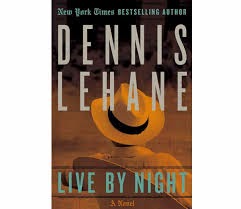
Live by Night, by Dennis Lehane
Dennis
Lehane has written many novels, several of which have been successfully
filmed. He centres his stories mainly in
Boston, Massachusetts and has always created great characters and great
plots. ‘Live by Night’ is a loose sequel
to ‘The Given Day’, an epic tale of the First World War, the soldiers who
returned and the police force they joined.
Racism and Baseball play a huge part in this fine book and it would be
an advantage for the reader to read this first, if possible, but ‘Live by
Night’ can stand alone on its own merits.
Joe
Coughlin is twenty years old when this story begins. He is the youngest son of one of the most
respected and prosperous senior police officers in the city of Boston, and he
hates his father. His two older brothers have long since fallen out with their
martinet parent and left home; his
mother has died, and Joe has happily turned to a life of crime – partly to
spite his old man, but also because he likes it. He doesn’t class himself as a gangster; he’s an outlaw, a euphemism which has a
better ring to it; it’s 1926,
Prohibition is in full swing and there are myriad opportunities to make piles
of money from this absurd law as a bootlegger for speakeasies: Joe is thrilled
with his circumstances and feels even better that his father, who knows
everything that transpires in Boston, is aware that he has a successful
criminal – sorry, outlaw – for a son.
Yep,
Joe is a is a Twelve O’Clock Fella in a Nine O’Clock Town; he lives by night, and the night has even
more appeal when he meets Flora Gould, a very shady young lady whose hunger for
thrills matches his own. Unfortunately,
she is the mistress of a real gangster called Albert White. Albert is averse to sharing his mistress with
Joe and in short order Joe’s life turns sour:
through a series of unfortunate
events he endures a terrible beating, hospitalisation, the loss of his great love
and an eventual stint in prison, the sentence of which is reduced thanks to his
father calling in some favours.
Like
it or not, Joe should now be repenting
at leisure. His father Thomas, despite
his supposed neglect of his youngest has sacrificed his promotion to help his
boy survive in prison with a shorter sentence;
all that matters to him now is that his son come out of the dreaded
Charlestown Penitentiary alive. Joe, far
from repenting (he’s only sorry that he got caught) devotes his energies and
considerable intelligence to surviving attacks from within – and without, eventually
forming a long-term alliance with a mafia man, Maso Pescatore. Ah, the road to Hell takes many forms, and
Joe’s journey covers a lot of ground before the eventual showdown and fight to
the death: this is a classic tale of
winning it all but losing everything in the process, and Mr Lehane tells it
beautifully. He is a master of suspense
and snappy dialogue; his research is
impeccable; he creates atmosphere and
times without any discernible effort and I defy any reader to finish any of his
books, then decide not to read another one.
Highly recommended.
The
Same Sky, by Amanda Eyre Ward
Two protagonists take turns to narrate this story; the first, Carla, is a young Honduran child
of eight who lives in extreme poverty with her grandmother and her two much
younger twin brothers. Her mother, in an
attempt to make a better life for her family has managed to make the hazardous
journey to America, land of gold-paved dreams;
she will eventually send for them all when she saves up enough money
from her job at Texas Chicken.
Alice is a Colorado girl transplanted to Texas after she
meets and marries Jake, whose family own a long-established BBQ
restaurant. Her life would be excellent
except for the tragic fact that she cannot have a child, thanks to cancer and
subsequent doses of chemotherapy. Jake
and Alice’s forays into surrogacy and/or adoption have also failed, and they
are resigning themselves with reluctance and sorrow to the fact that their
family will only ever consist of themselves.
Alice is not always a likeable character; she is disagreeable, contrary and downright
mean from time to time, especially when she sees Jake’s acceptance of their
situation as capitulation: where is his
gumption, his spine, the ‘never-say-die’ attitude that she possesses in
abundance? She is contemptuous of his
resignation, and embarks on several new attempts (all unrewarding) to satisfy
her thwarted maternal instincts.
Carla, meanwhile, has suffered tragedy: firstly, her mother saved enough money for
just one of her children to come to her in Texas; the woman who is delivering the child opts
for the ‘quiet one’, twin Carlos who has always been a steadying influence on
Junior, his sibling. Junior is bereft
and does not take the separation well; worst of all, Carla’s beloved grandmother,
their island in a sea of poverty and desperation, dies after a short
illness. Carla and Junior are alone.
Carla’s attempts to find a child’s solutions to her
terrible adult problems are portrayed with agonising and brutal clarity by Ms
Ward, who spares the reader nothing but the harsh, brutal truth of poverty and
such degradation that countless migrants will do anything, including risk
death, to Ride atop the Beast, the train that travels from Honduras to Mexico,
there (if they are still alive – and lucky) to swim or ride with ‘coyotes’
across the Rio Grande into Texas without being caught by border guards.
By comparison Alice’s life seems breezy and uncomplicated; she is loved (most of the time - she’s prickly); she and Jake have built the BBQ restaurant
into a thriving business; her family in
Colorado have produced three nephews for her to love – but it is not
enough: she will always want more. She will always want a child.
Ms Ward unites her two characters fleetingly at the end
of this wonderful story, for Carla eventually makes the journey to Texas after
suffering unspeakable torments on the way, only to realise that The American
Dream is just that; a dream that hides a
reality of drudgery and second-class treatment.
Reuniting with her mother has not been the rapturous experience that she
has always longed for; instead her
mother and Carlos hold her responsible for Junior’s absence. She is now twelve years old.
In today’s world cruelty, evil and poverty in many
countries is the terrible norm, and no writer in my experience has produced work more affecting and poignant, harsh and brutal, as
Carla and Alice’s story. By the very
simplicity of her prose, Ms Ward conveys life under the same sky as it is for
so many, and as it could be for a very few.
Most highly recommended.
A
Song of Shadows, by John Connolly
In
‘The Wolf in Winter’, John Connolly’s last opus (reviewed November, 2014 see
below) an attempt was made on the life of Charlie Parker, dark hero of most of
Mr Connolly’s books. He was grievously
wounded, but with a choice he made whilst hovering between life and death, and
the spiritual support (literally) of his murdered daughter (it pays to have
read the preceding books), Charlie decides to give life one more chance. With the devoted assistance of Louis and
Angel, hired killers par excellence he
rents a house in a little village on the Maine coast, there to try to regain
his former strength and dexterity.
It
is a long, painful road back to recovery.
Charlie is not used to the weakness and agony his many injuries cause
him but he is determined to get better:
he made the decision to live, now that is exactly what he plans to do.
He
is delighted to have a visit from his daughter Samantha, his child by his
ex-lover Rachel, and it gives him pleasure to have found a playmate for
her; his beach side neighbour, Ruth
Winter has a little girl Amanda who, despite health problems that keep her away
from school a lot, welcomes Sam’s company:
from a social perspective life is good.
Until
a body is found on a nearby beach, and it is eventually established that it
wasn’t a drowning or a suicide, but murder;
at the same time a family has been found murdered in their burning house
and the Maine police are swamped with crimes for which they are badly
under-resourced. Tragically, these
crimes pale into insignificance when Ruth Winter is cruelly murdered on the
night of Sam and Amanda’s playdate, but the most uncanny event for Charlie
Parker is that his daughter wakes him to tell him that a man is trying to enter
Ms Winter’s home. How could she know?
Charlie
is injured trying to apprehend the murderer on the dunes and it seems that
finally his own life is about to end – until Sam (who was under strict
instructions to stay in her bedroom) appears at his side to confront the killer
– who succumbs to burial under a massive fall of sand, an occurrence that
hasn’t happened for decades at that part of the beach .To say that Sam is no
ordinary little girl is an understatement.
It
is time for Charlie, with the assistance of Louis and Angel, to return to what
he is best at: investigating murder and
stamping out evil – if he can, and the deeper he delves into Ruth’s killing,
unspeakable old crimes and pure evil finally reveal themselves, for Ruth, a
Jew, was killed so that she would not disclose anything she may have
inadverdently learned about old Nazis:
Nazi war criminals who entered the United States from Argentina under
assumed identities, several of whom settled in Maine. None wish to be exposed and sent back to
Germany, and they will go to any lengths, including multiple murders, to stay
where they are.
Charlie
Parker is a different person now, after his close brush with death. There is an implacability, a hardness and
resolve about him that cause his loyal friends much disquiet but they are
determined – as always – to support him to the hilt in his efforts to purge
evil. Charlie is unfazed by the fact
that the battle may be uneven; what
nearly stops his heart is the knowledge that his daughter Sam is just as committed
as he to stamp out the enemies of the world, and he is fully aware that she is
in just as much danger.
As
always, Mr Connolly leaves his readers in terrible suspense right to the last
page - which only poses more questions
and enables this beautifully written series to continue. What a master he is, and what a pleasure it
is to read a Charlie Parker book. Highly
recommended.
The Wolf in Winter, by John Connolly
The town of Prosperous,
Maine lives up to its name. Founded in
the eighteenth century by persecuted religious fugitives from England, the
settlement grew and gradually flourished, whilst still retaining quaint old
buildings (why, they even brought their own church with them to assemble, brick
by brick!) and customs. The town is still governed by a hereditary
council of Selectmen, all descendants of the original inhabitants and, while
displaying courtesy to all who come to visit such a picturesque place, it will
be eventually noticed that Prosperous does not welcome new people to live
within its limits: Prosperous keeps to
itself.
Until the apparent suicide of Jude, a homeless man who
visited the town searching for his daughter, brings private detective Charlie
Parker looking for answers: while it is
hardly unusual that a man of the streets would want to end his life, the method
of death feels wrong, especially when Charlie checks into Jude’s movements in
the days before his death. Jude had
helped Charlie in the past; it is now up
to Charlie to do the right thing. If
Jude’s death was indeed suicide, was
it because of his daughter? Is she dead,
too? And if so, why? How?
Yet
again, Mr Connolly draws the reader into the web of Charlie’s latest dark
adventure. In modern Man of Sorrows
Charlie Parker and his two murderous sidekicks Louis and Angel, Mr Connolly has
created three unforgettable protagonists – and their enemies are legion,
especially The Collector, a self-appointed avenging angel of righteousness,
dedicated to ridding the world of those so evil that no lawful punishment is
fitting enough.
Charlie,
Angel and Louis have undergone more than one baptism of fire in preceding books
to seal their bonds of friendship and loyalty, but when they face the chilling
mystery that is Prosperous, one of their number is so grievously wounded that,
even as this great book comes to a close it is impossible to guess if he will
survive, let alone appear in a sequel.
I
take my hat off to Mr Connolly, first of all in praise of his wonderful
literary skills: there are many writers
who tell great stories but there are few who write with such clarity and
elegance. And it takes a rare talent to
make the supernatural element of every Charlie Parker story so credible, and
all the supporting characters so real that they are itching to step off the
page and do us harm.
That
said, how long will it take Mr Connolly to produce his next book – will there be a next book, with the life
of one of the Three Dark Musketeers hanging in the balance? It’s a big worry, one that I hope will be
removed soon.
In
his acknowledgements at the conclusion of ‘The Wolf in Winter’, Mr Connolly
thanks his readers for continuing to read ‘these odd little books’.
As if we could stop. AS IF!!
Highly recommended.




 Everyone has read of the evils of slavery in America and the war that was fought between the States to emancipate its victims, but less has been written about the equal injustice perpetrated by the British Empire, who transported slaves from Africa to harvest the huge sugar plantations they established in the Caribbean. Andrea Levy in her third novel, takes us back to the times of her forebears in early 19thcentury Jamaica, a time of complete dominance by the white planters, a time of regarding their slaves as livestock, to be traded, sold or disposed of any way they saw fit – until that same ‘livestock’ rose up in bloody revolt, leading eventually to King William 1V declaring an end to the British Slave Trade. This is Ms Levy’s first excursion into history; previously she has written tellingly and well of contemporary race relations in Britain; now she explores the rich and violent path of her ancestors in Jamaica, treating us to a life as seen through the eyes of Miss July, a house slave in the Big House of the Amity Plantation. At the end of her life, Miss July is writing her memoir at the behest of her son, and what a story it is, full of humour, cruelty, deprivation and great sorrow, for Miss July has been used badly – and has badly used people in return. Regardless, she is sly (she tells lies!), funny and utterly irrepressible; she is an unforgettable singer of ‘The Long Song’, as she calls her memoir: long may her music sound.
 It’s always a pleasure to recommend a book by Nelson de Mille - he is a consummate master of the perfect airport and beach read; his books are page-turners par excellence. He can get a little long-winded sometimes, but he’s ALLOWED. He produces so much high quality suspense in his writing that he can be forgiven for occasionally flagging in pace or getting bogged down with more detail than his readers think they need. In his latest book ‘The Lion’, sequel to ‘The Lion’s Game’ and the previous ‘Wild Fire’, Mr. de Mille has no problems at all with the tempo as he again treats us to his danger-prone and irreverent protagonist John Corey, Special Contract Agent (after various misadventures with the NYPD) for the FBI. John’s a bit of a maverick; bad guys seem to walk into his innocent fists often; he has been known to say ‘Who, me?’ when various villains fall unconscious (or even dead) at his feet: in short he treads a very fine line between permissible force and police brutality – not to mention insubordination - but he’s just the man to have onside against the most feared Islamic terrorist of them all, The Lion, back again to wreak death and destruction on long- suffering post 9/11 New York. Mr. de Mille is known for his impeccable and thorough research – at no time do we feel that we must suspend belief in the plot and its fascinating characters – until Mr. Corey ‘inadverdently’ causes another villain to bite the dust. And our Hero proves that he is indeed a well-rounded personality, for his daily existence has elements of the mundane from time to time. Normal life intervenes when his wife suggests that they go wine-tasting at the weekend: in his mind he replies ‘Wine tasting? WINE TASTING? What kind of crap idea is that?!’ In reality he says’ Darling, what a great idea, let’s do it.’ Proof, if we ever needed it, that Mr. de Mille is intimately familiar with real life situations as well as death-defying suspense. What a good writer he is, and how well he deserves his huge readership.
 This is a wonderful story. It has been a rare privilege to read such rich and beautiful prose, to be swept up and carried along by the relentless tide of history - even though we know the terrible outcome, for Ms. Orringer has written a novel of the Holocaust. This is a risky subject on which to write as everyone knows of the heinous crimes of the second world war, the extermination of millions of Jews, and the sheer tragedy visited upon families and generations yet to come, but the author succeeds admirably because of the strength and believability of her characters. The novel starts in 1937, when Hungarian student Andras Levi wins a scholarship to attend the Ecole Speciale, a venerable school of Architecture in Paris. His life and that of his brothers Tibor and Matyas are chronicled; their hopes, dreams and ambitions; their love affairs and eventual marriages; then the agonizing privations they suffer as part of Hungary’s Jewish ‘Labour Force’, cannon fodder as the expendable front line of Hungary’s Army fighting for Germany against the Allies. The war years are predictably horrendous, not only for the unimaginable loss of beloved family, but the destruction of entire cities and lifestyles, bombed out of existence. How could anything ever be resurrected from such annihilation? Despite the seriousness of the subject, Ms. Orringer has not written a tragedy; rather it is a compelling story of Life in all its guises; heart-wrenching, comic, dramatic, powerful, triumphant and moving – which is what life can be for all of us . FIVE STARS.
 Here be dragons – lots of them! For lovers of fantasy fiction, Stephen Deas is the new Flavour of the Month, and for those of us who previously decried such nonsense (like myself) – well, we’ll all have to eat our words, for Mr. Deas has effortlessly captured our attention, hearts and minds with the sheer brio and excitement of his story-telling, and he won’t release us until he finishes the series – however long that may be. Not that I mind, for he can tell A Story-and-a-Half: The Realms are a loose federation of Kingdoms who depend on their dragons for their power; bred, guarded and nurtured by their keepers, they are ridden by the aristocracy, used for hunting and warfare and kept docile by the Alchemists with a mysterious potion added to their food; without it they would return to their natural state, uncontrollable and terrifying, able to destroy armies and turn cities to ash – and one of them has escaped. The leadership of the Realms is also ready for change: enter Prince Jehal, power-hungry and unscrupulous, ready to murder if he has to – and he does, reaping unexpected and unwanted consequences. In fact the Prince, nasty as he is, gains the reader’s sneaky sympathy by the end of the second book of the series – what WAS he thinking? Couldn’t he see the danger coming? The fool better smarten up his act in Book 3! And so on. In other words, a complete entertainment, totally addictive with great characters – and those dragons. Oh, those dragons: I’d love one for a pet, if I had a place big enough to keep it (and several dairy herds to feed it). Perhaps I could do a deal to rent the Waitomo caves?