Thursday, 5 September 2024


The Trees, by Percival Everett.


            Southern trees bear strange fruit

            Blood on the leaves and blood at the root

            Black bodies swinging in the Southern breeze

            Strange fruit hanging from the poplar trees


The verses of the song above help Percival Everett walk the fine line between horror and satire with great success in this novel of the complicated revenge struck by Black people for the killing – mainly lynching – of Black people for more than a century.  His portrayal of the murders of the Good Ole Boys whose families were responsible for the lynching of 14 year-old Emmet Till in Mississippi back in the day is chilling, especially for the fact that each corpse had his testicles removed, clutched in the hand of a dead Black man, also at the crime scene.  The redneck local Sheriff assumes, as anyone would, that said Black man is the killer, even though he was shot in the back of the head:  murder/suicide.  Wrap this up, guys.

            Except that the killing doesn’t stop:  more bodies are found further afield, along with their presumed Black killer clutching testicles, causing the redneck Sheriff to suffer the indignity of having to accept assistance from two Black detectives from the Mississippi Bureau of Investigation, followed by a frightening Black woman agent from the FBI – cain’t they even be left to clean up their own crap??  Apparently not.

            In fact, no-one can, for the country is in for a reckoning:  there have been so many hate crimes and racially based murders that Black spirits are not the only victims calling ghosts to Rise;  Asians are hearing the call of Genocide, too.  How will it all end, especially when the current leader in the White House (in this story Donald Trump) gets jammed under his desk and can’t get out, discovering wads of chewing gum stuck in his hair, a sure sign that his VP had been trying out the desk for size – while he was Making America Great Again!

            Mr Everett paints a frightening, shamefully true picture of the woeful state of race relations in America, overlaid with superb, satirical humour from  characters who speak truth in every sentence:   every country needs such a chronicler.  Even though the truth hurts and is frequently unpalatable, it’s always preferable to lies.  SIX STARS.


Thursday, 22 August 2024

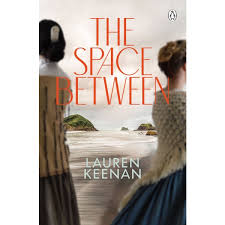
 The Space Between, by Lauren Keenan.


            Early 1860:  the British Crown has signed a Treaty with Maori and colonisation is in full swing;  settlers by the shipload have been arriving under the auspices of the New Zealand Company, new government agents (of a kind) charged with the immigration of those wishing to throw off the shackles of the stifling class system in Britain, hoping to make something of themselves and their families, and prepared to work hard to have a better life.  If only, for the class system has travelled on the ships with them:  it will take many, many years to shake off humble origins.

            In New Plymouth (called Ngamotu by those Maoris), a gentleman and his mother and shamefully spinster sister are trying their hand at farming.  George Farrington has been forced to leave England supposedly because their father lost all their money, then died – what was a man to do?  The Colonies seemed to be the only answer for someone so short of cash - the problem being that George was not a natural-born farmer, or a lover of the land, and his sister Frances, jilted cruelly by a ne’er-do-well called Henry White 12 years before has been raised as genteel – it is an entirely new experience for her to have to tend to fowls and milk cows, for their mother refuses to do anything that does not befit her station. 

            And to add insult to grievous injury, who should Frances meet outside Thorpe’s General Store but Henry White himself, there to meet his Maori wife Mataria – and Mataria shouldn’t have been there anyway because all Maori need a pass issued by the Military;  they are undergoing the laborious, humiliating process after their trip for supplies to the store.  Life has suddenly taken an equally harrowing turn for Frances and when brother George sees Henry and his wife talking with Frances he contrives to get the couple put in jail – no pass, no freedom!

            A military conflict is brewing, too:  the settlers want to expand the boundaries of New Plymouth and are dealing with a Maori representative who does not have tribal permission to sell any more land, but such is their desire to own more acres, they are arrogant in their belief in the rightness of their cause.  Of course!

            Lauren Keenan has portrayed events of the time with great clarity backed by strong historical research and her own tribal affiliation to Te Atiawa ke Taranaki.  She creates a superb portrait of a time that contained horrors that we can barely guess at – and the frail, perennial flowers of compassion, hope and affection that are essential for all of us to carry on.  SIX STARS.     


Friday, 9 August 2024


Joe-Nuthin’s Guide to Life, by Helen Fisher.


          Neurodiversity:  the 21st century’s current euphemism for the many  psychological illnesses and anxieties that beset modern society.  In the ‘Old Days’, anyone who was afflicted with a mental illness was just that:  mental, but these days there has been a concerted effort to bring the neurodiverse into daily life, to integrate them into ‘normal’ society, thus helping them to live their very best lives.

            In theory, for ‘normal’ society can be anything but. 

            Such a person  is Joe-Nathan.  He calls himself  that (his proper name might be Jonathan) because two names are like Dinner and Dessert – should anyone ask.  Joe lives with his widowed mother Janet, and works for the Compass Store, a big supermarket whose Boss Hugo sees the Brownie points accruing for employing Joe, who has Obsessive-Compulsive Disorder, but comes to like and admire him anyway, not only for his ruthless attention to detail, but also for the fact that Joe-Nathan is a lovely young man, stricken by a cruel syndrome, but with the help if his indomitable Mum, making the very best of things.

            Except for workmates Mean Charlie and his mate Owen:  they delight in calling him names – Joe-Nuthin – and threatening to open cans of red sauce because they know that anything red upsets him terribly – BUT!  Joe is not without friends who will defend him, particularly workmate Chloe, whose language is so bad that Joe makes her a swear-box that he calculates will make her rich within a year.  Chloe puts Mean Charlie in his place with a physical attack so violent Boss Hugo is forced to consult HR, resulting in Mean Charlie’s sacking.

            Job done!  Time for all to live in happy diversity ever after, but life, particularly these days, seldom follows the best script:  Joe’s darling mum has a fatal heart-attack and Joe is forced to face vast, monstrous changes in his life, living alone being just the first;  however, Janet has anticipated life for Joe and his struggles after her death and to that end has left two books of instructions, the first a ‘how-to’ cook, clean, repair etc’, and the second more important advice about friends and how to treat them, particularly if one wanted to keep them – which makes Joe think of Mean Charlie and the fact that he might have more sadness in his life than everyone thinks, particularly when Joe inadverdently sees all of Charlie's bruises.  It’s time to make a new friend, and Joe has decided that for good or ill, Mean Charlie is the one!

            Helen Fisher has written a beautiful story on friendship, the courage to be ‘other’, especially when there is no choice, and the beauty and necessity of humanity’s desire for affection.  My heart was full at story’s end.  Thanks HEAPS, Ms Fisher!  SIX STARS          

Tuesday, 30 July 2024


Knife, by Salman Rushdie.                       Memoir


    In 1989, acclaimed author Salman Rushdie was sentenced to a Fatwa by Iranian Ayatollah Ruhollah Khomeini –a  death sentence executed by any pious Muslim, for writing a novel called ‘The  Satanic Verses’, deemed to be contemptuous and scornful of Islam.  For the next several years, Rushdie was kept under 24 hour surveillance and reluctantly lived the life of a recluse, a fugitive who never knew when and where death would strike – until, finally, he became tired of living his life in the shadows;  he needed to feel the sun again, travel as he pleased, and socialise with his friends and loved ones:  to hell with Fatwas – he’d take the risk and live his life as he wanted to, in freedom.

            Until August, 2022, Salman Rushdie did just that.  Life was good;  he’d fallen in love (and it was reciprocal!); his new novel was about to be published, and he’d agreed to give a lecture at Lake Chautauqua, upstate New York on the importance of keeping overseas writers from harm, those in danger from fanatics from their places of origin.  What an irony for, as he was introduced on stage a black-clad figure rushed towards him brandishing a knife – a knife that inflicted numerous serious wounds before his assailant was overpowered and prevented from continuing.  Rushdie was taken by helicopter to hospital, and not expected to survive.

            ‘Knife’ is Rushdie’s personal account of his ordeal;  his grievous injuries – he has lost the sight of his right eye, and his left hand which he lifted in defence as the assailant rushed towards him has permanent damage to the tendons, not to mention numerous cuts and scarring on his body – are testament to an iron determination not to be a soon-to-be- forgotten  victim of religious bigotry and fanaticism, but to survive and still live his best life.  He pays grateful tribute to his family, friends and loving wife, all of whom never left his side – once they’d got there;  one of his sons had the misfortune to have a fear of flying, so had to come by sea from the UK, much to his chagrin, but he did it!  Meantime, the would-be assassin had pleaded not guilty to all charges, despite a packed auditorium of witnesses.

            Which prompts the victim to imagine several conversations with his would-be killer, none of which persuades a change of heart or mind:  Rushdie is evil and must be removed from the earth.  Okay then!

            But not yet.  Salman Rushdie has produced from awful personal experience  a darkly humorous, irrefutable treatise on religious tolerance, his own atheism and his unshakeable conviction that though knives are lethal, the Pen is always Mightier than the Sword.  FIVE STARS.           


Sunday, 21 July 2024


James, by Percival Everett.


            Percival Everett is a distinguished Black professor of English and a prize-winning novelist:  he is also a Pulitzer finalist, and eminently qualified to write a ‘What If’ story about the fates of two of American literature’s most beloved characters, Huckleberry Finn and the slave Jim, Mark Twain’s timeless, runaway heroes, and the various good, bad, strong and weak people they meet in their attempts to reach a place of safety.

            Jim finds out that his owner Ms Watson is planning to sell him down South;  that would be perfectly fine – if he were by himself, but he has a wife and little daughter that he loves above all else:  he can’t leave them – he won’t leave them:  without them he is nothing.  He will run and hide for a time until they stop searching for him, then he will return and take his family with him to safety.  Wherever safety may be.  Jim has heard that going North (he is in Missouri) is the best destination – if he remains uncaught:  if they find him he will either be beaten to death, or lynched.  Or tracked down by dogs who will not wag their tails when they see him.  But Jim knows a safe place, a little island in the nearby Mississippi river where he can hide out for a while; he can swim there and plan his next move.

            All well and good.  But someone else knows about the island, too – Jim is joined whether he likes it or not, by young Huckleberry Finn, who has staged his own death so that he doesn’t have to live any more with his Pappy ‘who shore does hate him!’ – Huck reckons it’s better to live in hiding with all the risks it involves than to be beaten bloody every night.  And that’s very true, except that Jim has a terrible sinking feeling when he hears that, for he knows that white folks will add two and two, and decide that runaway Jim has probably killed young Huck Finn:  how will he ever get back to his family with an extra imaginary crime hanging over him?

            Jim and Huck’s adventures in their attempts to avoid discovery are terrible, suspenseful and simultaneously uproariously funny:  the characters they meet travelling on the mighty Mississip are fitting heirs to Mark Twain’s genius for characterisation, and a tribute to Mr Everett’s formidable power as a writer – and a terrible indictment against the enslavement of one people by another.  Even though the story ends with the start of the American Civil War, the hatred hasn’t gone away.  SIX STARS.   


Sunday, 14 July 2024


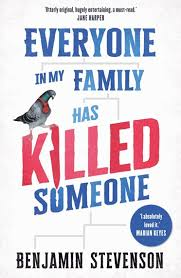
Everyone in my Family has Killed Someone, by Benjamin Stephenson.


Classic murder mysteries follow strict rules:  a set number of people are gathered (or thrown) together at a place that is difficult to escape from;  one by one, they are picked off in various clever ways, thus building suspense and horror in the reader;  the denouement always, always reveals a murderer that no-one would ever suspect, and the remainder of the novel deals with the satisfying punishment and demise of the guilty party.  The great Agatha Christie was, as we all know, the unparalleled mistress of the genre and her shoes will never be filled;  however, there have been plenty less famous – and less talented upstarts ready to try their luck, with varying success.

            Australian writer Benjamin Stephenson does the opposite:  he has written an enormously entertaining 21st century parody of that disparate group of people with grudges and grievances, in this case narrated by Ernie, disgraced within his family because he testified against his brother Michael at Michael’s murder trial – families stick together no matter what, and the Cunningham family has had more of its share of trouble with the law than it could possibly need or want.  He is the pariah in the family group organised to welcome Michael home after his mysteriously reduced prison sentence.  Everyone has gathered at a luxury ski lodge in the Snowy mountains, and Michael’s ex-wife Lucy is there hoping for a reconciliation;  unfortunately, Ernie’s ex (whom he still loves) shows up as Michael’s new lovebird and, true to form, the weather turns nasty:  what was meant to be a skiing weekend with lots of hot toddies and flash food is transformed into a violent storm that traps everyone, starting with a complete stranger killed in a most ancient and unusual way.  Victim One!

            The body count rises as the weather worsens;  Michael dies the same dreadful death as Victim One and when Ernie (he is the narrator, after all!) eventually gathers everyone together in the ski lodge library – a classic setting for so many Big Reveals – I feel I can say with confidence that no reader had guessed WhoDunnit, and  What Happened Next, because I certainly didn’t and I’m really good at that.

            Benjamin Stephenson has followed all the rules, in fact he has helpfully provided a copy of them at the beginning of the book – and he has given readers a laugh-out-loud, enormously entertaining variation of the genre with characters so good that I wish I could meet them in future works by him – but he’s killed them all off!  FIVE STARS.


Sunday, 7 July 2024


Listen for the Lie, by Amy Tintera.


       Lucy Chase is sent an airline ticket by her Grandmother to return to Plumpton, Texas, for Gran’s 80th birthday celebrations and, though she loves her Grandmother more than anybody, she really doesn’t want to return to a place where she may have murdered Savannah, her very best friend five years before, and where she had to leave because the lack of evidence to convict her did not lessen the gossip and speculation.

            A new life in Los Angeles has earned only temporary respite, for a new Podcast series ‘Listen for the Lie’ has started, and one of the cold cases it wishes to explore is Lucy’s very own and, despite her continued rebuffs of Podcaster Ben Owens, he has generated so much advance publicity raking over all the old coals that she loses her job – and her boyfriend, whose loss isn’t so bad, except that she will have to find another place to live and another job.  So!  Might as well bite the bullet and go back to help Gran celebrate.

            Except that Ben Owens has turned up in that small Texas town too, and everyone is happy to talk to him – except Lucy:  why should she help him make money out of an event of which she can remember nothing?  For Lucy was found wandering along a road, semi-conscious, concussed and covered with her friend’s blood:  despite various mysterious and damning circumstances, she can remember nothing and, despite her longing to know what really happened, the thought that she may have killed her dearest friend is too horrifying to think about.  So she won’t, so there!  It’s a shame that no-one else feels like that, though – even her parents don’t believe that she could be innocent, and her ex-husband (another big Lucy mistake) has completely different memories of Savannah’s last night of life.  What really happened when Lucy and Savannah left the wedding celebrations to which they were invited?  Lucy can’t face it.  But if she didn’t kill Savannah, who did?

            Amy Tintera has previously written for Young Adults;  this is her first adult novel, and she has given us unforgettable, cranky, smart-mouth Lucy as narrator – the first big plus.  The second is a clever plot that unfolds logically and credibly, and the third:  a cover blurb by Stephen King and Liane Moriarty!  Those two really know what’s good, and they are absolutely right:  this is a FIVE STAR read.